 Alexandra Y. Aikhenvald
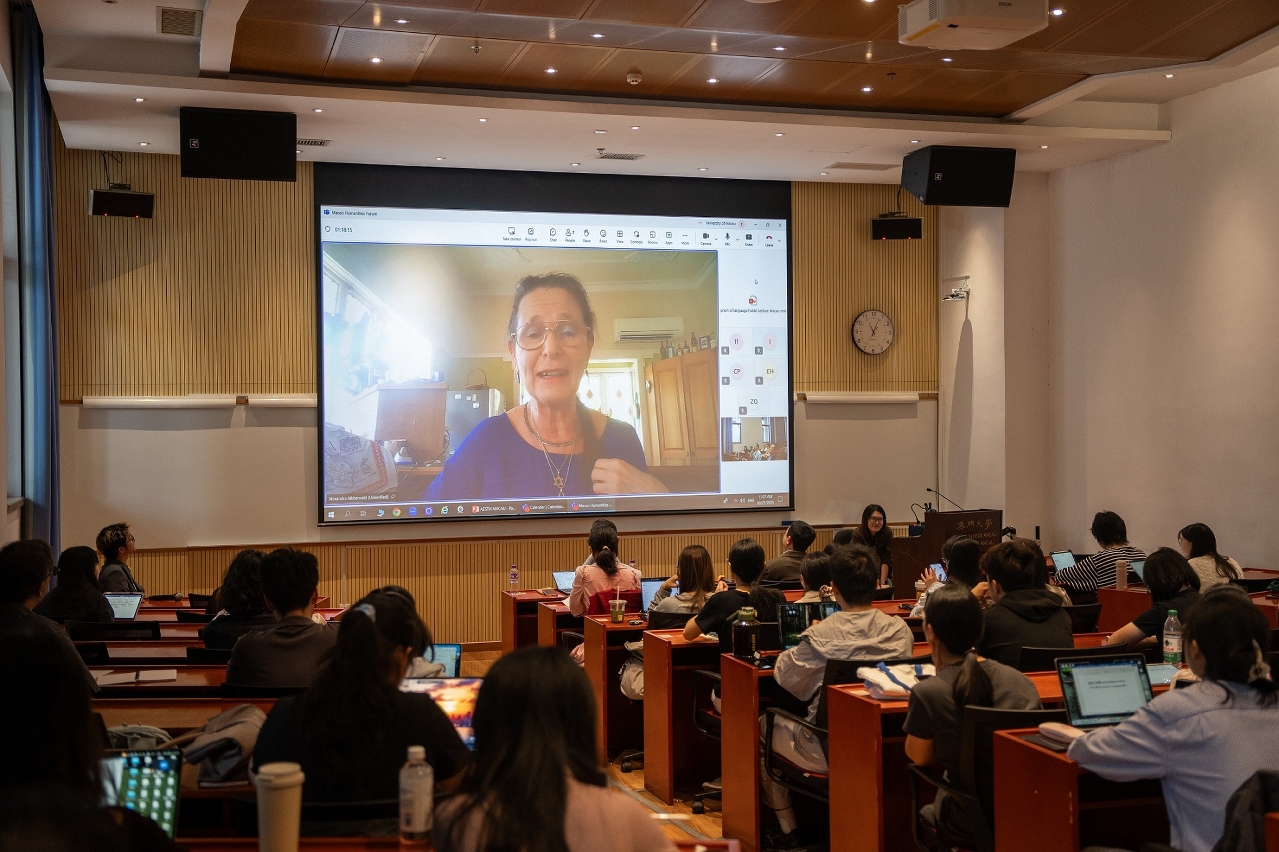
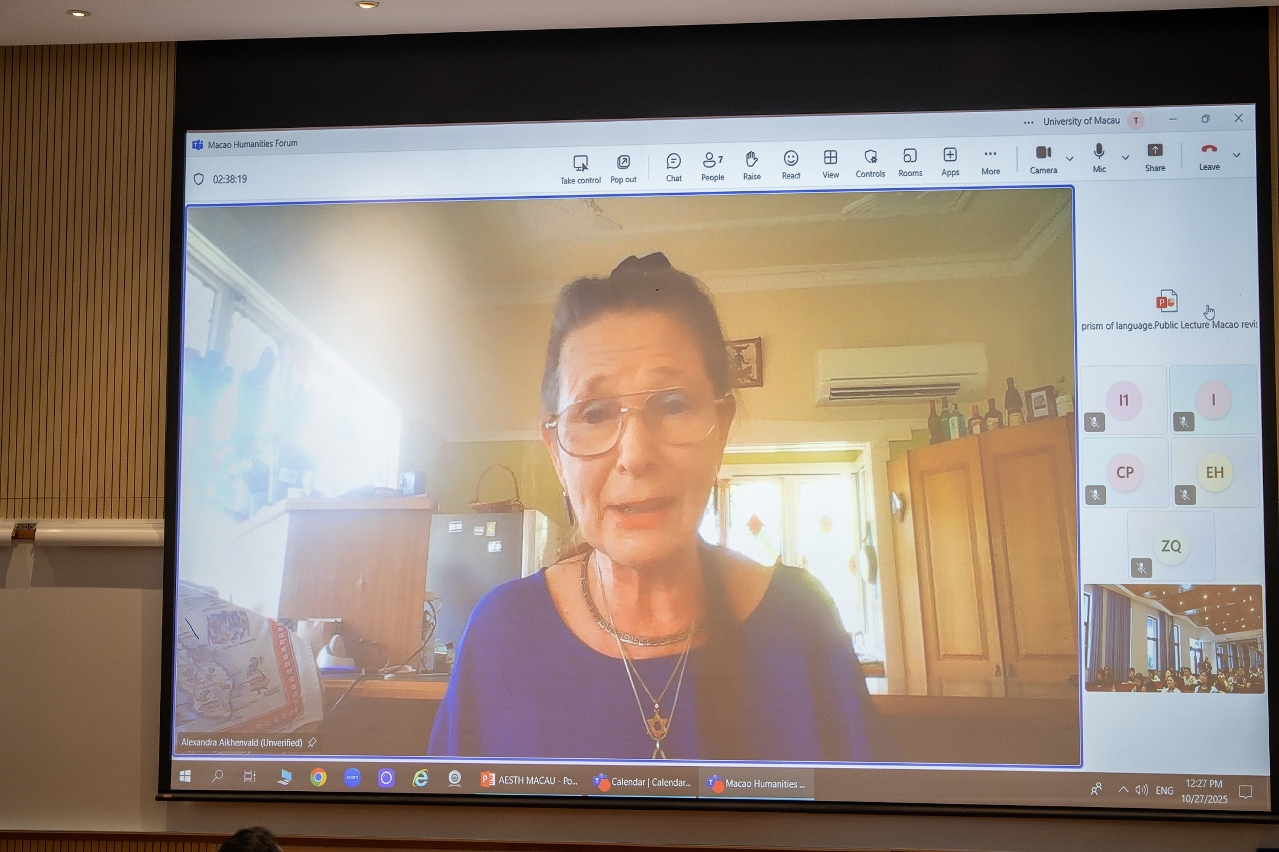
The Faculty of Arts and Humanities (FAH) of the University of Macau (UM) held the Macao Humanities Forum, where Alexandra Y. Aikhenvald, an Australian Laureate Fellow and professorial research fellow at the Jawun Research Institute of Central Queensland University, delivered a lecture titled ‘The world through the prism of language: what are gender and classifiers good for?’. The forum was well attended by students and faculty members.
Speaking at the event, Joaquim Kuong, assistant dean of FAH, highlighted the forum’s focus on linguistic typology, which explores structural diversity and commonalities among languages and deepens the understanding of the relationships between language, cognition, knowledge, and culture. Yang Wenjiang, head of the Department of Japanese of FAH, introduced Aikhenvald’s academic background and achievements, noting that she is an internationally renowned linguist with an outstanding reputation for her research on Amazonian and Papuan languages, as well as linguistic typology. Aikhenvald’s research areas include evidentiality, classifiers, gender, and serial verb constructions. Her representative works include Classifiers: A Typology of Noun Categorization Devices and How Gender Shapes the World, both of which are published by the Oxford University Press. Aikhenvald’s pioneering efforts have significantly advanced the development of linguistic typology and have had a profound impact on the linguistics community.
During the lecture, Aikhenvald introduced foundational concepts in gender and classifiers, delineating their typological categories and functional roles. She noted that grammatical gender involves morphological agreement on adjectives, demonstratives, modifiers, and predicates, a phenomenon observable in languages like Portuguese. She further explained that grammatical gender may encode sociocultural values and biases, as seen in some South American languages where erudite women are accorded masculine markers as a sign of respect, and conversely in English, where referring to men with feminine terms serves to demean them. Aikhenvald then turned to classifiers and explained how they reflect the lifestyles and culture of societies. For example, Thai once had a set of hierarchical classifiers, which have now evolved into polite generics as social structures loosened. The existence of unique classifiers often reflects the special status of culturally significant objects. For example, Chinese has the classifier pǐ for horses, while Tariana has a dedicated classifier for canoes. Aikhenvald further linked classifiers to language evolution, acquisition, and attrition. She noted that broad classifiers are often derived from specific ones. In language acquisition, children pick up classifiers sequentially, while in language dissolution, classifiers acquired later are often the first to disappear.
During the Q&A session, UM students and faculty members engaged in discussions with Aikhenvald on the variation of classifiers and the dynamic interplay between language and culture. Aikhenvald noted that classifiers and gender markers in language are not merely grammatical tools but potent indicators of social status, emotional proximity, education level, and power dynamics.
This was the second lecture of the Macao Humanities Forum for the 2025/2026 academic year. Eachyear, the forum invites distinguished scholars in different fields of the humanities to share their latest research findings with students and faculty members in Macao. Previous lectures of the forum have covered a wide range of topics, including literature, linguistics, history, translation, and arts.