

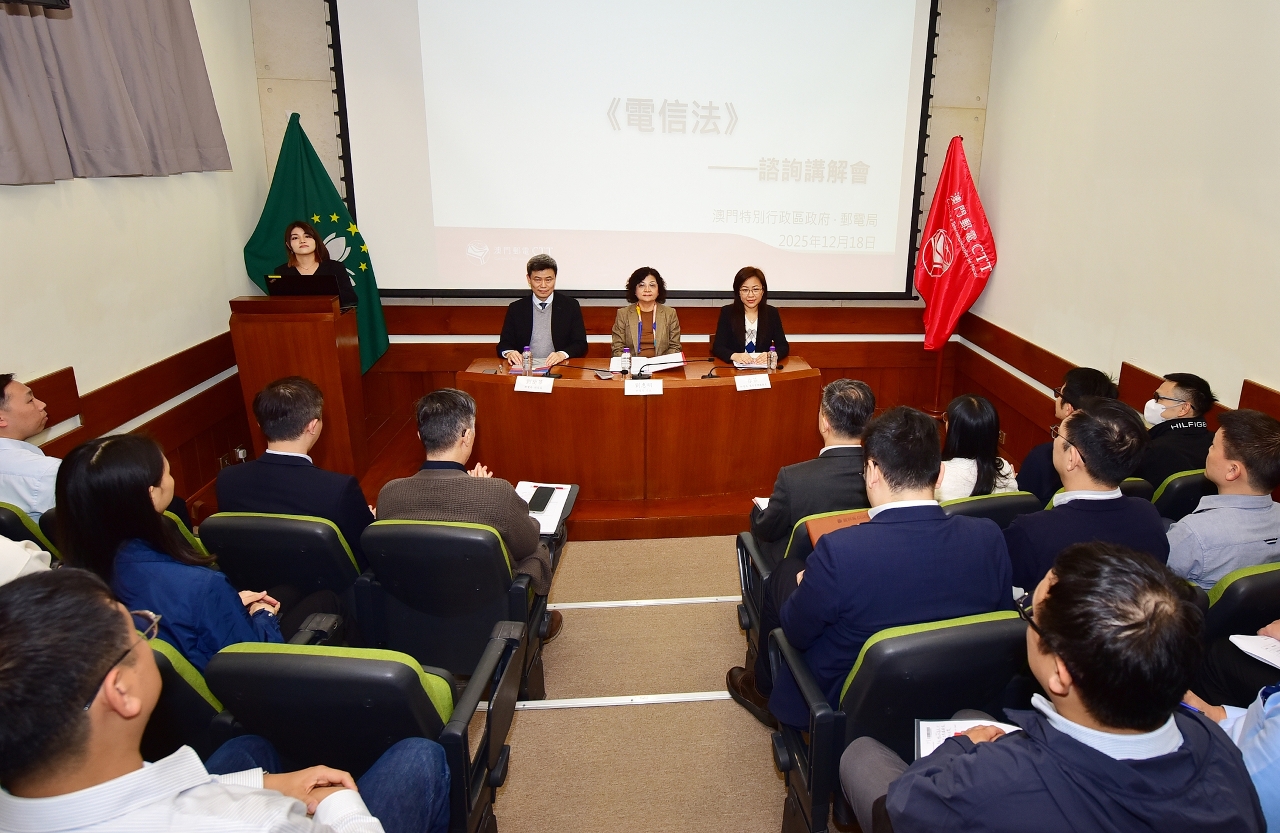
 CTT Organises Consultation Sessions on the Telecommunications Law
In order to align with the rapid development of communication technologies and the socio-economic digital transformation, the Government of the Macao Special Administrative Region (MSAR) has been actively promoting the legislative work of the Telecommunications Law. In order to further refine the content of the draft law, the Macao Post and Telecommunications Bureau (CTT) launch a 30-day industry consultation between December 4, 2025 and January 2, 2026. On December 18, two industry consultation sessions were convened, presided over by CTT Director, Ms. Lau Wai Meng and senior officials. The purposes of these sessions were to present the contents of the draft law in detail to industry representatives, professional associations, and government departments, and to gather valuable opinions.
The overarching objective of the Telecommunications Law is to establish a comprehensive and forward-looking legal framework for the construction, management, operation, and provision of telecommunications networks and services in Macao. The new legislation will replace Law No. 14/2001 “Basic Telecommunications Law”, which has been in force for over two decades, by introducing a convergence regulatory regime focused on “technological neutrality”. In accordance with the new regime, the processes of network construction and service provision will be subject to independent licensing, adopting an application-based system.
Network operators will be empowered to accelerate the construction of public telecommunications networks through the utilization of shared passive infrastructure or by leasing duct space and associated facilities from providers designated by the MSAR Government. In cooperation with network operators, service providers can develop innovative telecommunications services as standalone or bundled offerings. The regulation of the price for telecommunications services will be streamlined to enable telecommunications companies to respond more swiftly to market changes. In instances where competition within the telecommunications market is insufficient, specific regulatory obligations may be imposed on companies that are deemed to possess significant market power.
In the contest of safeguarding consumer rights and interests, telecommunications companies are obligated to implement compensation mechanisms for users in the event of incidents that have a significant impact on services. Furthermore, it has proposed the financial penalties to be imposed for violations of the law by telecommunications companies will be increased, and that mandatory pecuniary sanctions may be applied. It is to be noted that holders of existing licenses and concessionaires of telecommunications contracts may opt to transition to the new license within six months of the law coming into force.
This consultation constitutes a significant stage in the legislative drafting process. During the sessions, CTT representatives explained in detail the key points of the Telecommunications Law. Representatives from various parties actively participated, presenting numerous constructive opinions and suggestions, to which CTT officials responded and provided clarifications, fostering active and in-depth exchanges. On the occasion, Director, Ms. Lau Wai Meng expressed gratitude for the participation of all parties and emphasized the hope that, through this consultation, the industry, professional associations, and government departments will jointly contribute to improving the draft law by widely sharing their views. CTT will comprehensively analyze the collected opinions, striving to build a higher-quality business environment, enhance the quality of telecommunications service, and promote the joint development of Macao’s telecommunications industry and the MSAR.