

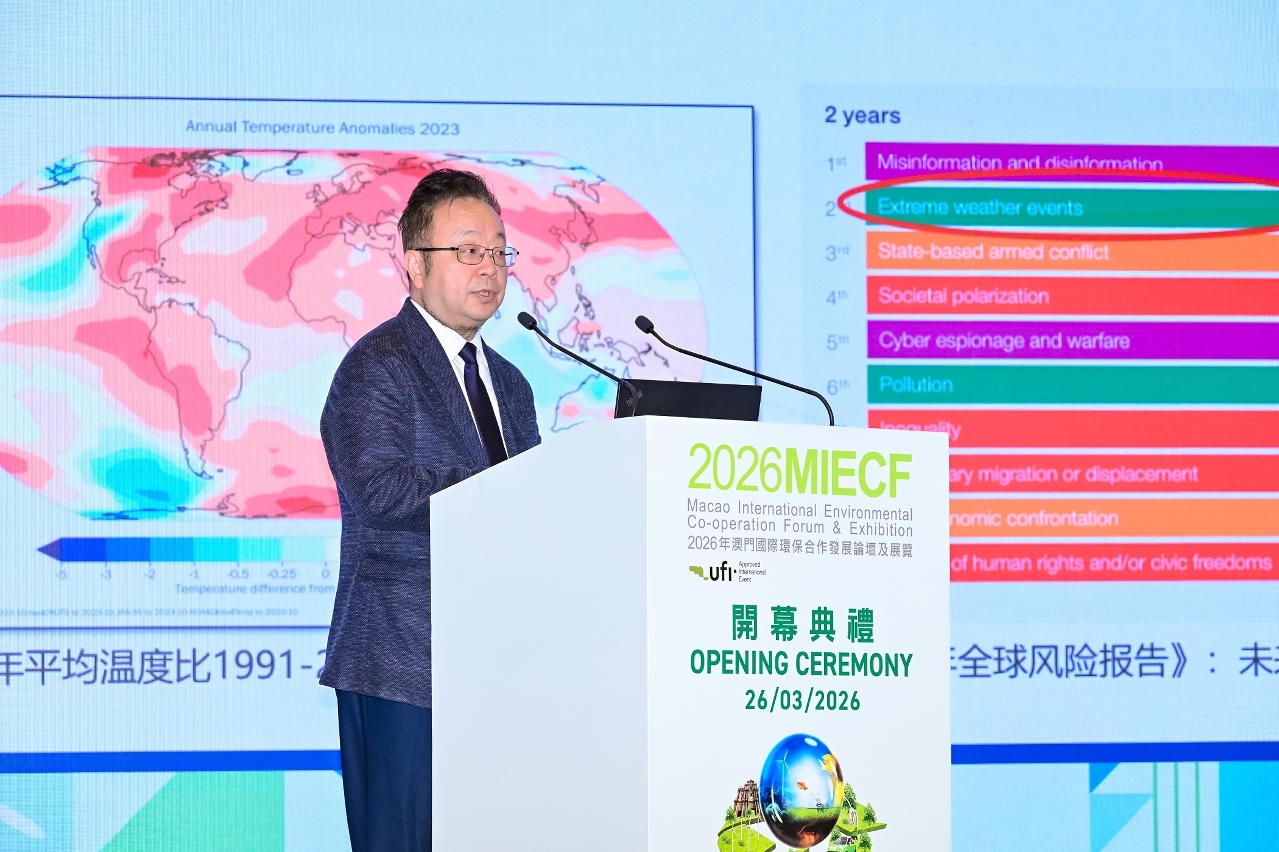
 He Kebin, Professor of the School of Environment, and Dean of the Institute for Carbon Neutrality at Tsinghua University, Academician of the Chinese Academy of Engineering, delivers a keynote speech
The 2026 Macao International Environmental Co-operation Forum & Exhibition (hereinafter referred to as the “2026MIECF”) has invited He Kebin, Professor of the School of Environment, and Dean of the Institute for Carbon Neutrality at Tsinghua University, Academician of the Chinese Academy of Engineering, to deliver a keynote speech titled “Dual Carbon Initiatives and Zero Waste City Development” on 26 March at opening ceremony. Against the backdrop of the “dual carbon” strategy, Academician He systematically reviewed the progress of China’s “Zero Waste Cities” initiative and provided practical references and policy recommendations to further enhance synergies between solid waste management and the “dual carbon” strategy.
Sharing insights on the “dual carbon” goals and zero-waste cities
In line with China’s “dual carbon” goals, Academician He Kebin – a leading authority on national carbon neutrality research – outlined five key carbon reduction pathways in his keynote speech, namely, enhancing resource efficiency, restructuring the energy mix, storing carbon in geological formations, sequestering carbon through ecosystems, and carbon financing via market mechanisms. He cited research data indicating that the development of a circular economy contributes 35% to the nation’s overall carbon reduction targets.
Promoting the close integration of the “dual carbon” goals with zero-waste city development
Academician He Kebin gave a systematic account of the progress of China’s “Zero Waste Cities” initiative, from pilot projects to steady implementation, including the exploration of a “Zero-waste Bay Area” co-construction model in the Guangdong-Hong Kong-Macao Greater Bay Area. He also noted the long-term goal of achieving nationwide coverage of zero-waste cities by 2035. During the 15th Five-Year Plan period, the “Zero Waste Cities” initiative will intensify, with the integrated model of “zero-waste construction and carbon emissions reduction” emerging as a new driving force in urban green transformation. He suggested that efforts should be increased to further refine technical standards and methodological frameworks to support the close integration of the “dual carbon” goals with zero-waste city development, in order to jointly create a green future. Additionally, he emphasised that a variety of innovative solutions, including satellite remote sensing technology, drones, and artificial intelligence, can be employed to intelligently identify and monitor sources of solid waste, thereby providing digital support for the development of zero-waste cities.
The three-day 2026MIECF, themed “Low-carbon, Zero Waste Cities: Embarking on a Global Collaboration”, features a series of professional international forums, exhibitions, Green Matching, Green Public Day, and networking activities. The event seeks to establish an international platform for environmental exchange and co-operation among different sectors, including “governments, industries, universities, research institutes, users, and investors”, thus propelling green innovation and industrial implementation while jointly advancing high-quality, sustainable green development at regional and global levels.
