

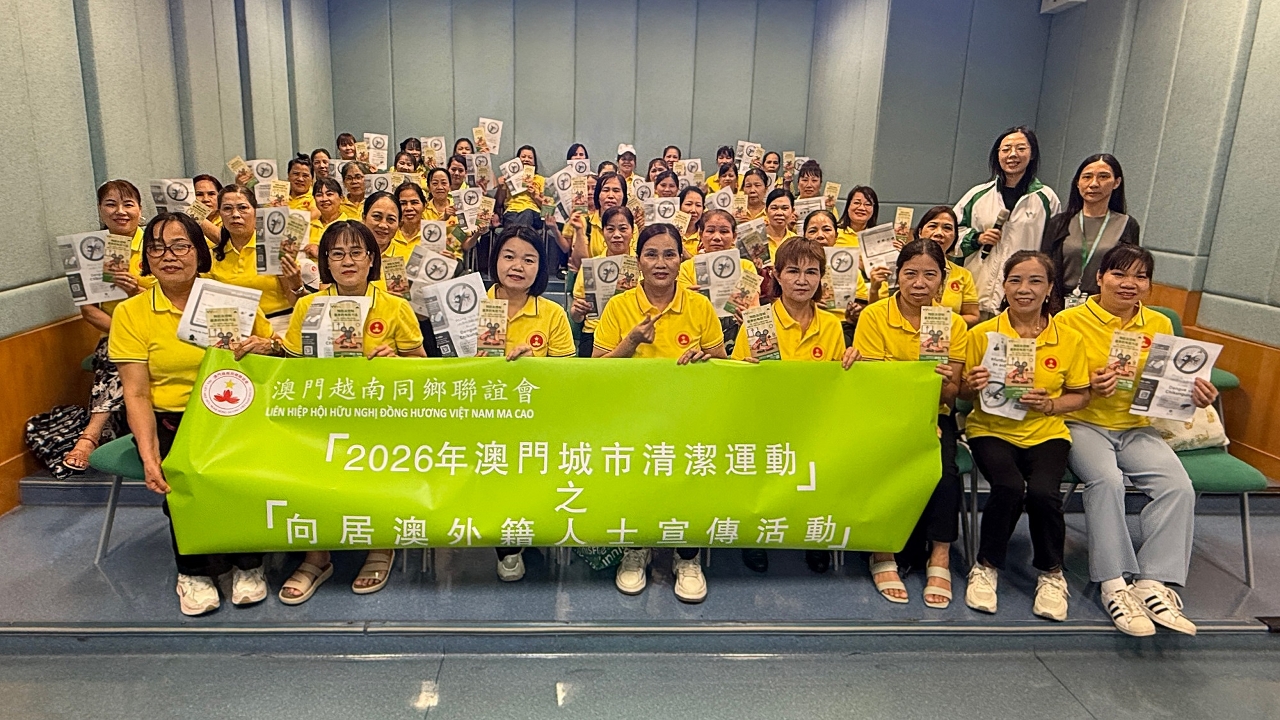
 IAM works with Health Bureau to hold a talk for foreign nationals living in Macao on mosquito and rodent prevention and control for raising awareness of maintaining environmental hygiene
To further strengthen mosquito and rodent prevention and control efforts in the local community, the Municipal Affairs Bureau (IAM) and the Health Bureau recently held a talk on “mosquito and rodent prevention and control” for the Association of Vietnamese Compatriots in Macao, aiming to raise awareness regarding mosquito and rodent prevention and control as well as environmental hygiene among foreign nationals living in Macao, expanding the disease prevention network through community collaboration.
With the arrival of summer, Asian tiger mosquitoes have become highly active, and the risks of transmission of dengue fever and chikungunya fever (hereinafter referred to as the “two fevers”) continue to rise. Meanwhile, rodent issues remain a significant and long-standing concern for environmental hygiene in neighbourhoods. As domestic workers are responsible for daily household cleaning and hygiene care, they play a crucial role in preventing mosquito and rodent infestations.
This talk was primarily aimed at Vietnamese domestic workers in Macao and was delivered in both Chinese and Vietnamese. It focused on key measures for rodent prevention and control, explaining the “three no’s” principle based on Macao’s living environment: 1. Remove food sources that may attract rodents (no food), properly dispose of food scraps and refuse, and use lidded trash cans; 2. Eliminate the hiding places of rodents (no hiding), avoid clutter accumulation and maintain a clean environment; and 3. Block the routes accessible by rodents (no entry), repair cracks and holes in walls to prevent them from entering.
Representatives from the Health Bureau explained the disease characteristics, transmission routes, and prevention methods concerning the “two fevers” in detail, in addition to the habits of mosquitoes and their common breeding sites, highlighting regularly checking and clearing containers of stagnant water as a crucial mean to prevent mosquito proliferation. Participants were also advised to take personal protective measures, such as wearing light-coloured, long-sleeved clothing and using appropriate mosquito repellents. Furthermore, individuals returning to Macao from abroad who develop symptoms such as fever, joint pain or skin rash should seek medical attention promptly and inform the doctor of their place of residence and travel history, in order to facilitate timely testing and report of suspected cases. The relevant testing services are available at the Health Bureau’s Public Health Laboratory.
The organisers hoped that participants would gain deeper understanding of practical mosquito and rodent prevention and control measures through the talk and apply them in their daily work and lives, jointly safeguarding the environmental hygiene in the neighbourhoods. Furthermore, it was aimed to expand the community’s disease prevention network by leveraging close-knit social networks and community platforms. IAM emphasises active participation of the entire community as a key to effective mosquito and rodent prevention and control, and will continue to strengthen public education and inspections, working hand-in-hand with the community to maintain a sound living environment. For information about the “two fevers”, members of the public may call the Health Bureau’s Infectious Disease Hotline at 2870 0800 or visit the dedicated webpage at https://www.ssm.gov.mo/csr.

