The Chief Executive, Mr Sam Hou Fai, cordially shakes hands with the Portuguese Minister in the Cabinet of the Prime Minister and of Territorial Cohesion, Mr Manuel Castro Almeida, during a meeting held in Lisbon, Portugal.
The Chief Executive, Mr Sam Hou Fai, met with Portugal’s Minister of Economy and of Territorial Cohesion, Mr Manuel Castro Almeida, in Lisbon, Portugal, on Monday (20 April). The two exchanged views on further deepening economic and trade cooperation between Macao and Portugal, and on supporting Macao in better fulfilling its role as a bridge between China and Portuguese-speaking countries.
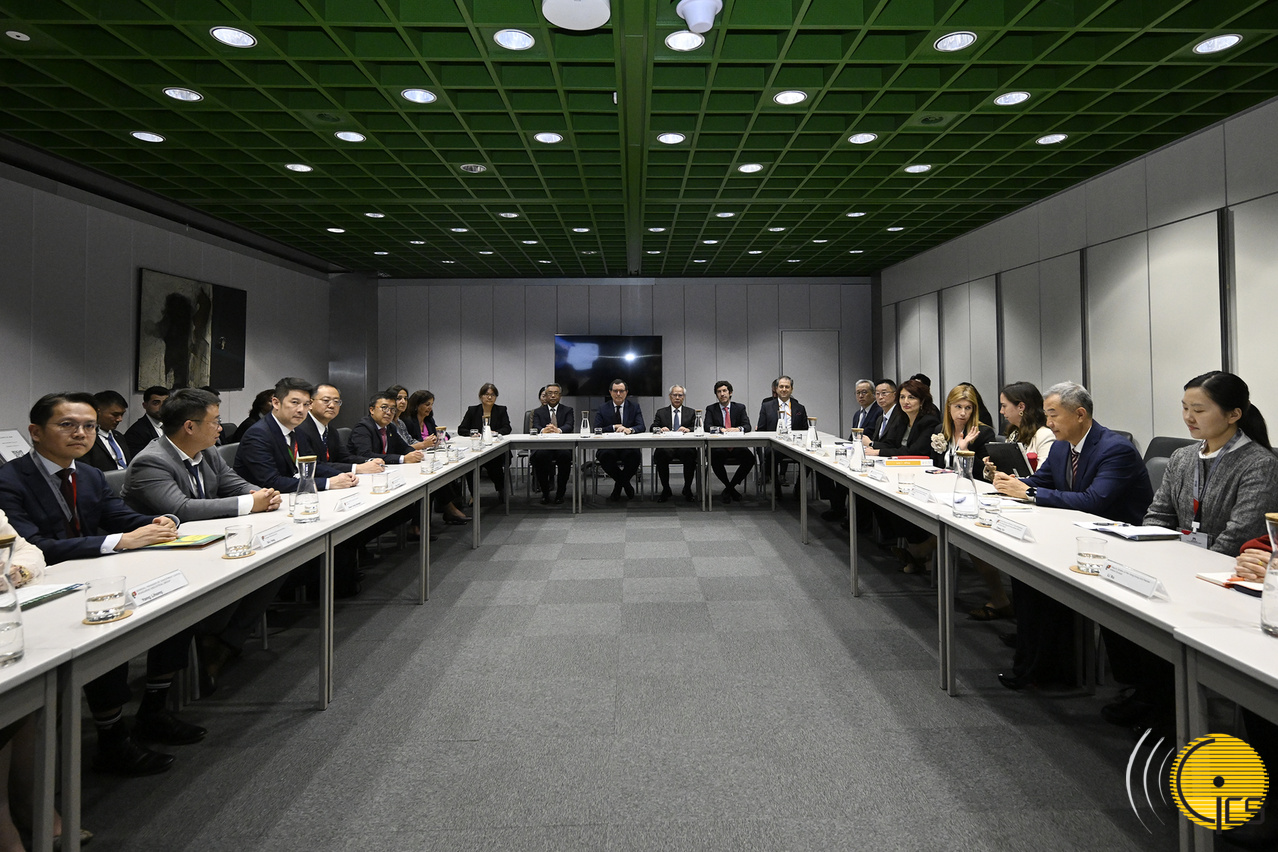
Subsequently, Mr Sam and Mr Almeida met with representatives of the business delegation accompanying the Chief Executive on the visit to Portugal, in order to discuss establishing links and creating a platform for exploring business opportunities.
Mr Sam expressed his gratitude to Portugal for its long-standing support for Macao’s economic development. He noted that, due to Macao’s unique strengths – such as its dual-language, Chinese and Portuguese, environment and its continental European legal system – the Macao Special Administrative Region (MSAR) has become a bridge for economic and trade cooperation between China and Portuguese-speaking countries, helping enterprises from both sides to explore jointly third-party markets, and achieve mutual benefit and win-win outcomes.
The MSAR Government is accelerating the development of appropriate economic diversification and is making steady progress in the development of four major key infrastructure projects. Portugal possesses competitive advantages in sectors such as science and technology, education, tourism, and conventions and exhibitions. Mr Sam said he looked forward further to expanding exchanges and cooperation between the two sides in these fields, establishing a platform for coordination, and strengthening mutual collaboration.
Meanwhile, the Guangdong-Macao Intensive Cooperation Zone in Hengqin serves as a key platform for Macao continuously to expand its development opportunities. It offers preferential measures in various areas, including business operations and taxation, and welcomes more Portuguese enterprises to invest and establish operations, Mr Sam noted.
Macao will actively fulfil its role as a “precise connector” between China and Portuguese-speaking countries, continuing to deepen economic and trade cooperation between China and Portugal, expanding Macao’s international air route network, boosting the efficient flow of personnel, and facilitating business exchanges, he stated.
Mr Sam added that since Macao’s return to the motherland, the MSAR Government has consistently prioritised and safeguarded the rights, customs, and cultural traditions of Portuguese that are resident in Macao. At the same time, the MSAR Government has actively promoted the teaching and dissemination of the Portuguese language locally, resulting in a steady increase in the number of students learning the language. This serves to strengthen Macao’s bilingual advantage in Chinese and Portuguese, thereby providing sustained momentum for Macao better to fulfil its role as a platform.
Minister Almeida said that since Macao’s return to the motherland, under the implementation of the “One country, two systems” principle, the region has achieved social stability and economic prosperity, with its development achievements plain for all to see. Thanks to the unique and irreplaceable relationship between Portugal and Macao, the region boasts a wealth of legal and linguistic talent, enabling it to maintain close ties with Portuguese-speaking countries.
Mr Almeida pointed out that Portugal attaches great importance to its friendly relations with China, and that he himself had advocated many years ago for the teaching of Chinese in local primary schools, so as to seize at an early stage the opportunities presented by China’s development.
At present, Portuguese enterprises are continuing to expand their operations in Macao, taking advantage of Macao’s role as a bridge between China and Portugal, actively participating in the development of the Guangdong-Hong Kong-Macao Greater Bay Area, and gaining access to the vast market of the Chinese mainland.
At the same time, Macao serves as an efficient, secure and convenient bridge for Chinese enterprises seeking to expand into Portuguese-speaking countries. Mr Almeida noted that – in addition to supporting the strengthening of economic and trade ties between Portugal and Macao – he has consistently supported professionals from all sectors in Portugal to seek and seize development opportunities in Macao.
Mr Sam and Mr Almeida then met with over 20 business representatives accompanying the delegation on its visit to Portugal, to exchange views and forge connections. Both officials expressed the hope that these entrepreneurs would seize the opportunities for cooperation between China and Portugal, in order to expand their own businesses, whilst also contributing to the continued deepening of Macao’s role as a platform, and the further strengthening of economic and trade cooperation between China and Portugal.
Officials attending the meeting included: the Chinese Ambassador to Portugal, Mr Yang Yirui; the Chief-of-Office of the Chief Executive’s Office, Ms Chan Kak; the President of the MSAR’s Commerce and Investment Promotion Institute, Mr Che Weng Keong; the Director of the Macao Economic and Trade Office in Lisbon, Ms Lúcia Abrantes dos Santos; and the Deputy Director of the Executive Committee of the Guangdong-Macao Intensive Cooperation Zone in Hengqin, Mr Cao Jin Feng.
Also present included: Portugal’s Secretary of State for Economy, Mr João Rui Ferreira; the Consul-General of Portugal in Macao, Mr Alexandre José dos Reis Leitão; the Chief-of-Office of the Ministry of Economy and of Territorial Cohesion, Ms Ana Tojal; and the President of the Portuguese Trade & Investment Agency, Ms Madalena Oliveira e Silva.