

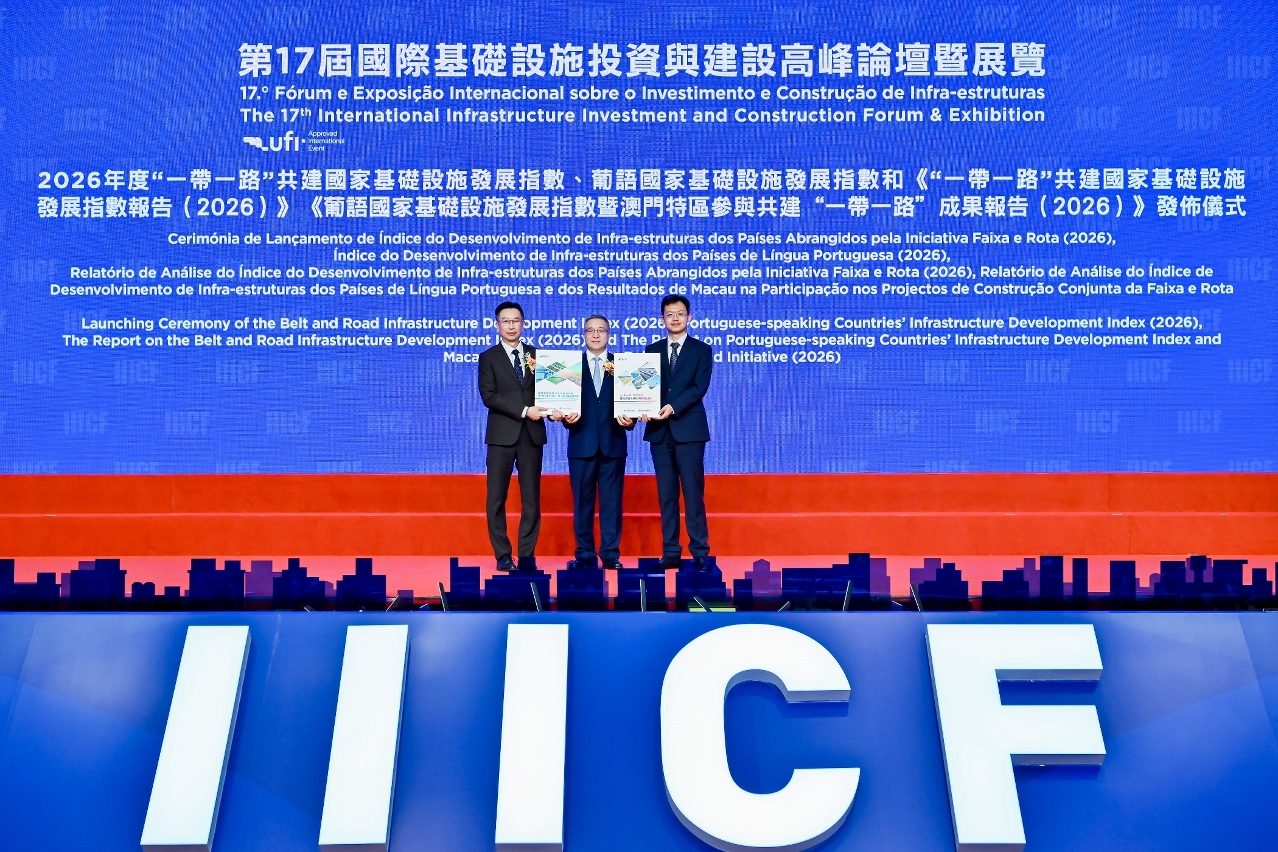
 The Belt and Road Infrastructure Development Index (2026) and the Report on Portuguese-speaking Countries’ Infrastructure Development Index and Macao’s Achievements in Belt and Road Initiative (2026) are released on 11 June
The 17th International Infrastructure Investment and Construction Forum & Exhibition (17th IIICF) released the Belt and Road Infrastructure Development Index (2026) and The Report on Portuguese-speaking Countries’ Infrastructure Development Index and Macao’s Achievements in Belt and Road Initiative (2026) on 11 June. The reports provide the industry with authoritative and forward-looking data analysis, with the aim of serving as an important reference for government policymaking, business investment and international co-operation, while highlighting and reinforcing Macao’s role as a “precise connector” between China and Portuguese-speaking countries (PSCs).
“Belt and Road” infrastructure market remains stable and positive, with broad prospects for synergistic co-operation across the new energy industry chain
The Belt and Road Infrastructure Development Index (2026) reflects trends in regional infrastructure development and provides a basis for the industry to identify transformation directions and emerging opportunities. The report highlights four key messages:
First, the “Belt and Road” (BRI) infrastructure market continues to show long-term positive momentum. The overall infrastructure development index of the 75 participating countries has increased steadily for six consecutive years. More than two-thirds of the countries recorded higher index scores, indicating a stable recovery in the international infrastructure market and a clear long-term positive trend.
Second, Southeast Asia continues to lead among regions. Saudi Arabia, Indonesia, and Malaysia ranked as the top three countries in the country-specific index.
Third, integrated development and cross-border connectivity are creating new opportunities for new energy projects. “The integration of energy generation, grid, load and storage” has become the mainstream in the transformation of new energy infrastructure among participating countries, enlarging the scope of synergistic co-operation across the new energy industry chain. Projects are evolving from point-to-point connectivity towards the joint development of comprehensive network frameworks, and the coordination of rules and standards. The deployment of cross-border power grid interconnection projects is accelerating simultaneously.
Fourth, supporting policies and institutional coordination are providing safeguards for infrastructure co-operation. Governments are expediting the introduction of dedicated infrastructure plans and supporting fiscal policies, while international organisations and regional co-operation platforms continue to strengthen efforts in policy coordination, regulatory alignment, and financial support, thereby creating favourable conditions for international infrastructure co-operation.
The report also notes that all parties should effectively guard against and respond to risks and challenges related to geopolitics, economic volatility, and regional security. It recommends strengthening policy and institutional safeguards, enhancing enterprises’ overall competitiveness, innovating financial service models, and improving industry coordination mechanisms to jointly promote the steady and sustainable development of “Belt and Road” infrastructure investment and construction co-operation.
Infrastructure development in Portuguese-speaking countries has remained stable, and Macao’s role as a platform has been prominent
IIICF has continued to strengthen infrastructure co-operation between China and PSCs. Across previous editions, co-operation agreements worth a cumulative USD 19.5 billion have been signed between China and PSCs, while the authoritative indices released during that period have provided practical support for such co-operation. The Report on Portuguese-speaking Countries’ Infrastructure Development Index and Macao’s Achievements in Belt and Road Initiative (2026) provides a comprehensive analysis of infrastructure development across the nine PSCs, showing that development remains on a steady trajectory, with Brazil, Mozambique and Angola ranking in the top three positions. The report also fully recognises the Macao SAR Government’s efforts in steadily expanding the functions of the China-PSCs co-operation platform and continuously deepening co-operation mechanisms, as well as its fruitful achievements in serving economic and trade co-operation between China, PSCs and BRI partner countries.
The SAR Government will continue to leverage Macao’s role as a bridge and platform between China and PSCs, facilitate more international co-operation projects, and contribute to regional connectivity and coordinated development. Industry stakeholders and members of the public may visit the official websites (https://www.chinca.org or https://www.ipim.gov.mo) to view and download the full versions of the two reports.
