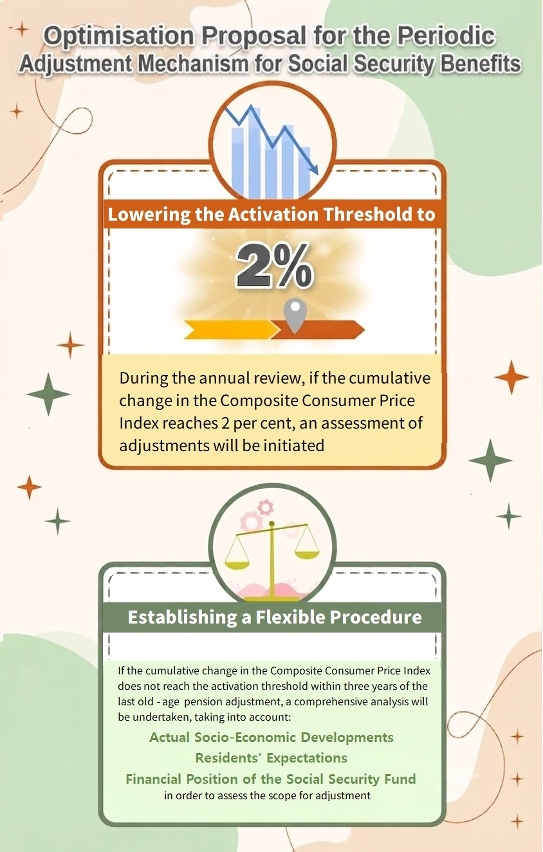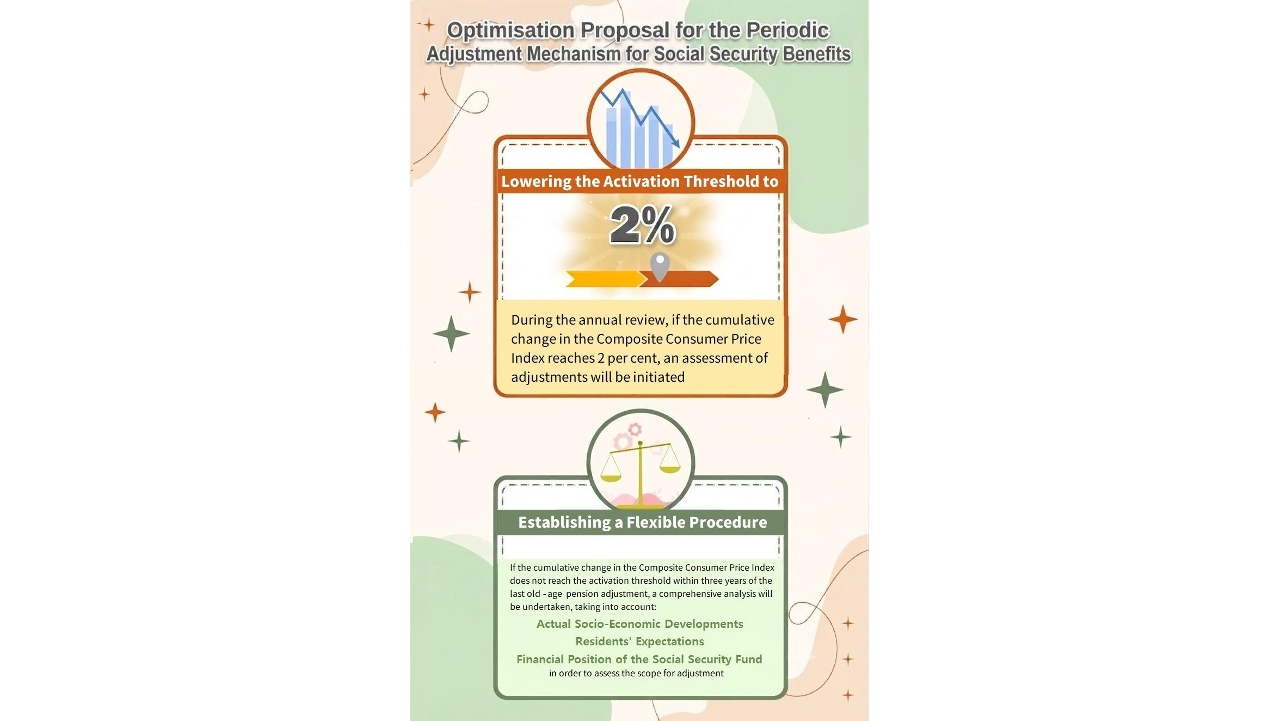
On 21 July, the Social Security Fund presented its proposal to optimise the Periodic Adjustment Mechanism for Social Security Benefits (hereinafter referred to as the “Adjustment Mechanism”) during the plenary session of the Standing Committee for the Coordination of Social Affairs. The proposal was unanimously endorsed by representatives of both employers and employees. The measures include lowering the activation threshold of the Adjustment Mechanism (the cumulative change in the Composite Consumer Price Index) to 2% and establishing a flexible procedure to ensure that old-age pension adjustments occur at intervals of no more than 3 years. The Social Security Fund believes that these optimisations will enhance the mechanism’s responsiveness to price fluctuations, thereby ensuring that adjustments to old-age pension and other benefits are more closely aligned with the needs of the population.
To further improve the Social Security System and balance its sustainability with residents’ reasonable expectations of benefits, the Social Security Fund commissioned the University of Macau in 2025 to conduct a specialised study titled Feasibility Study on Linking the Old-Age Pension Adjustment Mechanism with the Minimum Subsistence Index (hereinafter referred to as the “Study Report”). Drawing on a literature review, stakeholder interviews, and actuarial assessments, the Study Report put forward recommendations for optimisation.
The Study Report noted that the current mechanism uses the Composite Consumer Price Index as the reference indicator, which is sufficiently representative, reasonable, and reliable, reflecting changes in purchasing power across society, including among the elderly. It is therefore appropriate to continue using the Composite Consumer Price Index as the parameter. To enhance responsiveness to price fluctuations, the Study Report proposed lowering the activation threshold from the current cumulative 3% change to 2%, taking into account Macao’s average inflation trends in recent years. Furthermore, to avoid stagnation of the Adjustment Mechanism during periods of prolonged mild inflation, the Report recommended setting a target for old-age pension adjustments at intervals of no more than three years, supported by a flexible procedure. Under this procedure, if the cumulative change in the Composite Consumer Price Index does not reach the 2% threshold within three years of the last old-age pension adjustment, the Social Security Fund may still take into account the actual socio-economic situation, residents’ expectations, and the Social Security Fund’s financial capacity to assess the extent of the old-age pension adjustment.
Following the recommendations, the Social Security Fund will closely monitor price changes and social developments while adhering to the principle that the old-age pension, together with the Subsidy for Senior Citizens, shall not fall below the Minimum Subsistence Index, thereby ensuring a basic level of protection for the elderly. When the conditions set by the Adjustment Mechanism are met, the Social Security Fund will prepare proposals, seek the Standing Committee for the Coordination of Social Affairs' views, and put forward recommendations for benefit adjustments.
Regarding the feasibility of linking the full pension amount to the Minimum Subsistence Index, the actuarial assessment in the Study Report concluded that such linkage would inevitably accelerate the depletion of the finances of the Social Security Fund and undermine the sustainability of the system. The summary of the Study Report (only in Chinese Version) has been made available on the Social Security Fund’s website for public consultation.