Macao (China) PISA Governing Board Member (PGB) and Director of DSEDJ Kong Chi Meng (centre), Macao (China) PISA National Project Manager (NPM) and Chief Advisor of Educational Testing and Assessment Research Centre of Faculty of Education of University of Macau Prof. Cheung Kwok Cheung (left), and Head of Department of Educational Research and Planning of DSEDJ Wong Chio In (right)
On 8 September 2026, the Organisation for Economic Co-operation and Development (OECD) released the results of the Programme for International Student Assessment (PISA) 2025 simultaneously around the world.
The research team at the Educational Testing and Assessment Research Centre of the Faculty of Education, University of Macau, which has long been responsible for Macao’s PISA studies, pointed out that many OECD countries have seen a decline in learning outcomes in recent years. Macao, by contrast, has maintained a remarkably stable performance across successive PISA cycles, reflecting the long-standing emphasis of Macao’s curriculum on STEM education, reasoning skills and digital literacy. In addition to nurturing a large number of high-performing students, Macao has also kept its share of low performers effectively in check, placing it among the world’s top education systems.
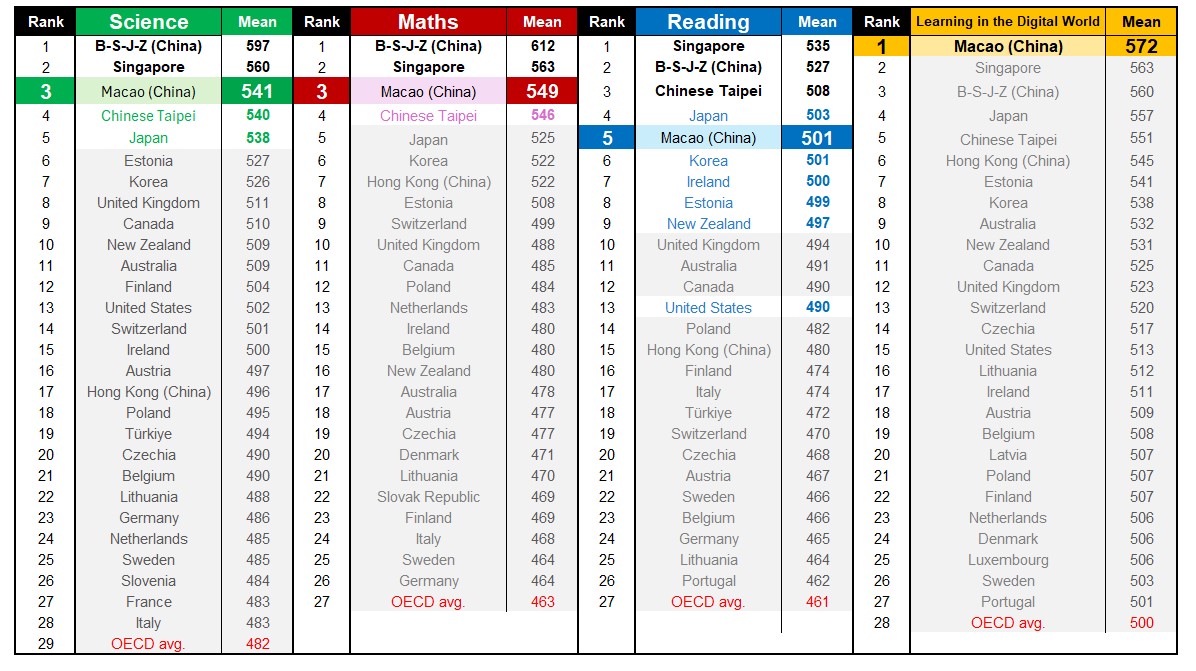
Ranking 3rd Globally in Science and Mathematics, 5th in Reading, and 1st in Computational Problem Solving
The research team noted that, among the 91 participating countries and economies worldwide, Macao students once again demonstrated outstanding learning outcomes and a strong ability to apply their knowledge and skills. Their performance in scientific and mathematical literacies ranked 3rd across the globe, while in reading literacy, they ranked 5th worldwide. Furthermore, given the growing importance of artificial intelligence (AI) in this era of transformation, ‘problem solving using computational tools’ was newly introduced to this cycle as a core competency of the ‘Learning in the Digital World’ (LDW) domain, and Macao students performed particularly well in this area, ranking 1st globally.
Maintaining Leading Position in Educational Equity, with Students Equipped to Effectively Tackle Challenges
According to the PISA 2025 results, Macao has continued to combine educational excellence with equity. In addition to maintaining world-leading academic performance, Macao’s education system has successfully narrowed the gap between socio-economically advantaged and disadvantaged students, with family background having only a modest impact on achievement. This shows that Macao can deliver both educational excellence and equity and stand as a model of a high-performing, high-equity education system.
Notes: Only countries/economies with mean scores above the OECD average are included in the ranking and score table. Countries/Economies whose mean scores were significantly higher than those of Macao are shown in bold. Those whose mean scores were not statistically different from Macao’s are displayed in the same colour scheme, while those whose mean scores were significantly lower than Macao’s are shaded in grey.
Notably, a substantial proportion of Macao students attained the highest proficiency levels (Levels 5 and 6) in STEM-related domains. The percentages reaching these top levels were 14.5% in science, 28.8% in mathematics, and 53.7% in computational problem solving. At the same time, the proportion of low-performing students who did not reach the baseline level (i.e. below Level 2) remained among the lowest in the world. Schools in Macao ensure that nearly all 15-year-old students possess the core literacies and competencies required to participate in societal affairs, enabling them to navigate real-life challenges and opportunities effectively.
Outstanding STEM Skills and Effective Policy Support
PISA 2025 shows that Macao students have a solid command of STEM. They demonstrated the ability to integrate scientific inquiry, mathematical reasoning and computational thinking when tackling challenging tasks. Particularly noteworthy were their programming and modelling skills in digital learning environments. They were capable of iteratively developing, testing and refining programmes and models to produce solutions that were efficient, concise and accurate. These mutually reinforcing STEM competencies give students a firm foundation for digital transformation, emerging technologies and future careers.
Macao’s achievements in PISA 2025 owe much to the support of the country and the MSAR Government. In particular, the MSAR Government has actively implemented education reforms, safeguarded investment in education, and ensured the effective allocation of educational resources to schools. It has also provided comprehensive support tailored to the needs of students and young people at different stages of development, enriched their learning experiences, strengthened their affection for and sense of belonging to the country, and helped them develop their strengths. While improving academic performance, Macao has also attached great importance to student well-being. Through sustained dedication, support and professional guidance, schools and teachers have fostered a learning environment that balances care with discipline. This fully reflects a student-centred educational philosophy, as well as their professionalism and commitment to nurturing the next generation.