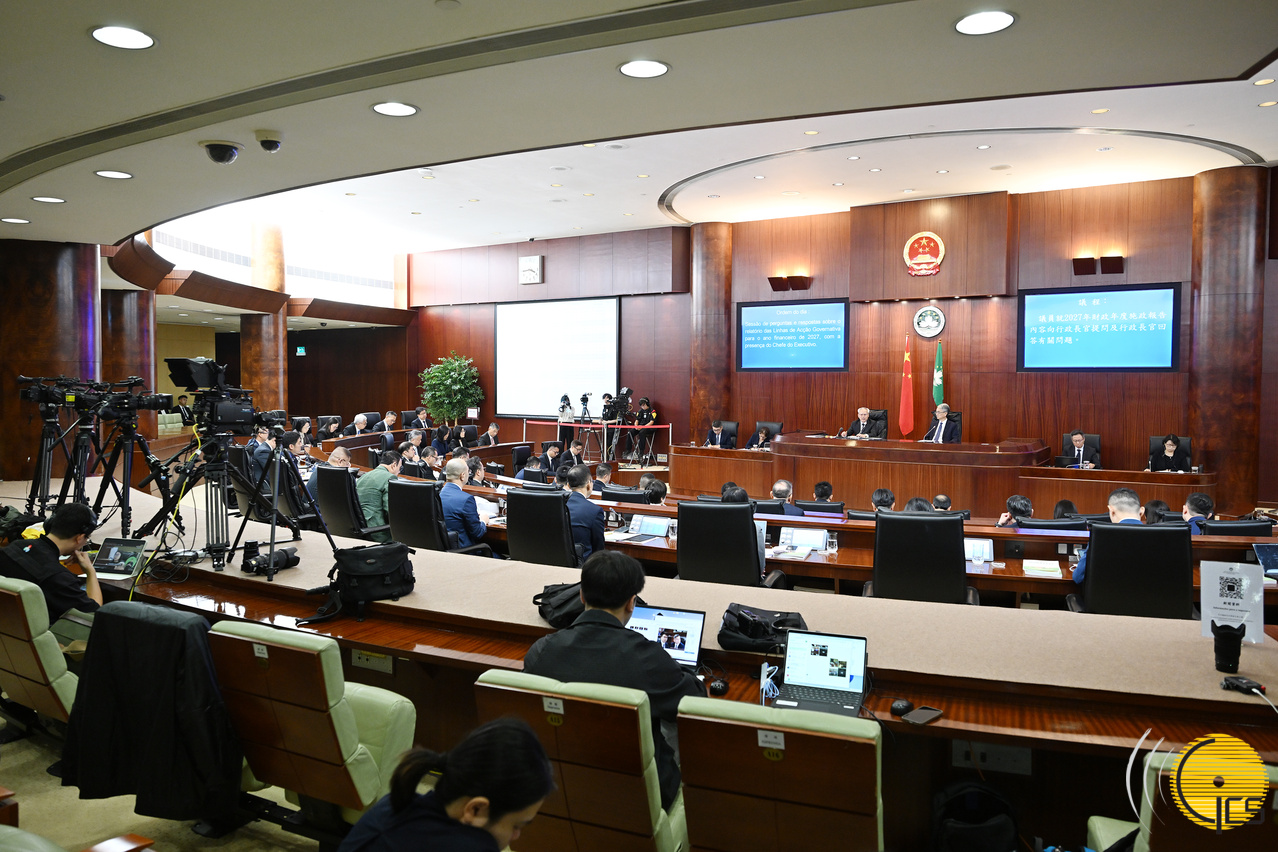
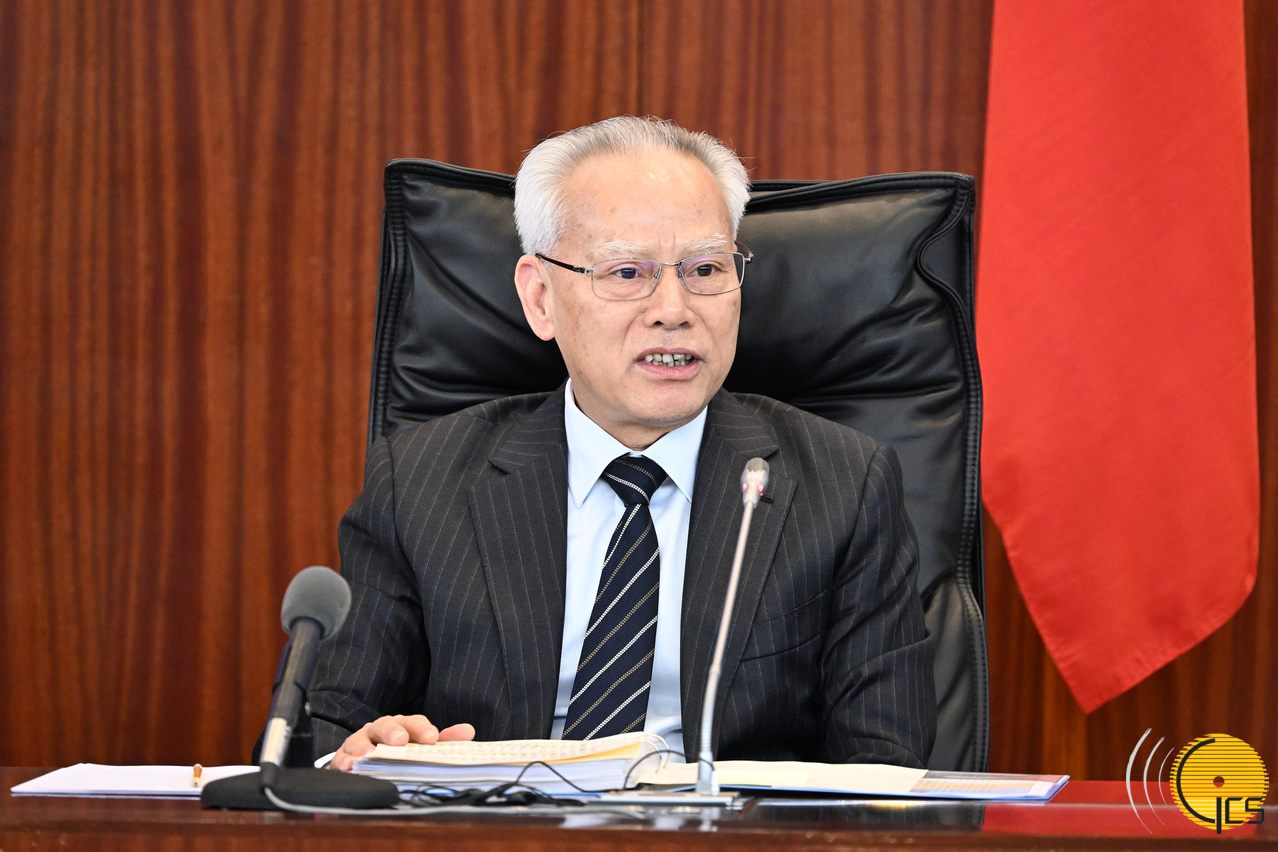
 The Chief Executive, Mr Sam Hou Fai, attends a plenary session of the Legislative Assembly to answer questions raised by Legislative Assembly members concerning the 2027 Policy Address.
Urban renewal is not only an essential building block of urban development but is also closely linked to the improvement of public wellbeing, the facilitation of economic diversification, the preservation of cultural heritage, and the enhancement of urban governance. Its success relies on the support, collective drive, and active participation of the entire society and the general public.
The Chief Executive, Mr Sam Hou Fai, made the remarks on Tuesday (17 November) during a question-and-answer (Q&A) session at the Legislative Assembly on the 2027 Policy Address.
Responding to legislators’ questions on urban renewal, Mr Sam said the initiative was a time-consuming and complex task that needed the concerted efforts of the Government, society and residents. This is to achieve the development goal characterised by “government guidance, market-based operation, area-specific approaches, comprehensive utilisation, and the integration of redevelopment and revitalisation with zone development.”
According to statistics, there are currently 1,650 buildings containing over 30,000 residential units that are 40 to 49 years old in Macao. Meanwhile there are 1,730 buildings aged 50 years or older, containing more than 17,000 residential units. The Government has established a steering group for the promotion of urban renewal, chaired by the Chief Executive, which oversees two subordinate working groups. This complex coordination framework is designed to be highly task-specific. Through building surveys conducted in pilot areas and comprehensive project assessments, the Government aims to ensure the smooth advancement of urban renewal initiatives while preserving the areas’ unique cultural heritage, ultimately fostering an environment that is both liveable and appealing to visitors.
Regarding the revitalisation of the Ruins of St. Paul’s and the Pátio do Espinho districts through “micro-renewal” initiatives, Mr Sam said the Government intended to proceed in a phased, systematic manner. Initial efforts will focus on specific, smaller zones as pilot projects before extending these initiatives to the broader area surrounding the Ruins of St. Paul’s and the wider historic district. Furthermore, the Government has established a special working group for the renewal and revitalisation of the Pátio do Espinho to accelerate spatial planning and environmental improvements in that area. Approximately 70 percent of the land in the Pátio do Espinho is currently state-owned. Urban renewal requires the support and participation of patriotic organisations as well as the general public. The process will also create opportunities for local industry professionals to engage in and contribute to the development, noted Mr Sam.
Regarding healthcare, the Chief Executive said that it is a vital component of social welfare. Public medical services in Macao are primarily provided by Conde de São Januário Hospital and the Macao Medical Centre of Peking Union Medical College Hospital (PUMCH). The Health Bureau is currently developing a clinical service plan for the public healthcare sector, which aims to clarify the roles and responsibilities of these two medical institutions while fostering their complementary development. The two hospitals have established a close collaborative mechanism, including a dedicated task force to facilitate the rollout of clinical services at the PUMCH Macao Medical Centre, thereby continuously alleviating the service demand on Conde de São Januário Hospital. In the first three quarters of this year, the PUMCH Macao Medical Centre accounted for approximately 14 percent of the total volume of public medical services.
Mr Sam reiterated that the Government attached great importance to the synergistic development of the public and private healthcare systems, with a focus on maintaining a balanced ratio between public and private services. To this end, it has built a more comprehensive and financially sustainable public healthcare system, while also supporting private medical institutions in delivering high-quality care, thereby offering residents a more diverse and superior healthcare experience. Furthermore, the Government is committed to facilitating access to medical services for the elderly. A collaborative task force has been established between the two hospitals, which—through the deployment of personnel, sharing of equipment, and coordination of spaces—has enhanced public healthcare services and resulted in effective overall operations.
Regarding declining birth rates and population ageing, Mr Sam pointed out that the Ten-Year Action Plan for Elderly Services (2026–2035) is being implemented in an orderly manner, with ongoing efforts to refine elderly care services and strengthen support for caregivers. Individuals aged 65 or older will continue to benefit in 2027 from various measures—including pensions, old age allowance, the Wealth Partaking Scheme, healthcare vouchers, and the special allocation from budget surpluses—receiving a maximum annual total of 78,400 patacas. Furthermore, they will continue to enjoy free medical care, fare exemptions on public transport, and other priority services.
To address the issue of a declining birth rate and encourage childbirth, the Government will continue to provide childcare allowances in the coming year, while introducing a tiered structure for these benefits. It will also expand free childcare services and implement additional subsidy measures. Efforts to enhance protections for female employees will continue. Under the amendments to the Labour Relations Law—which took effect in July 2026—paid maternity leave has been extended from 70 to 90 days. Furthermore, a Maternity Leave Remuneration Subsidy Scheme has been introduced, providing eligible employers with a subsidy covering up to 20 days of maternity leave pay.
Regarding job matching and employment support services for local workers, Mr Sam said the Government upheld the principle of prioritising local residents for employment. Leveraging interdepartmental mechanisms—such as the Employment Promotion Coordination Working Group—the Government continuously tracks job vacancies, facilitates job matching, provides career counselling, and offers a wide range of support services to job seekers. Relevant government departments, in collaboration with social partners and neighbouring regions, have strengthened cooperation to launch training and certification programmes—utilising models such as “integrated training and certification” and “paid on-the-job training”—covering fields including digital skills, conventions and exhibitions, the “Big Health” industry, specialised finance, and artificial intelligence. These initiatives are designed to support Macao’s “1+4” strategy for appropriate economic diversification and to enhance the capabilities of the local workforce. The Government has also introduced specialised “employment-plus-training” programmes to help young people acquire cutting-edge skills and successfully enter the job market.
Mr Sam pointed out that the Government was committed to advancing administrative and legal reforms. The Government will continue to optimise its organisational structure and clarify the allocation of functions. By integrating performance reviews, it aims to build an efficient, streamlined, and collaborative administrative system. Guided by the principle of “ensuring everyone’s talents are fully utilised”, the Government will comprehensively enhance the cohesion and execution capability of the civil service. At the same time, adhering to the principle of simplifying administration for the benefit of the public, the Government will leverage technology to deepen the application of e-government and further streamline administrative procedures.
The Government is systematically advancing the review and revision of major legal codes, with the goal of building a modern, law-based Macao. The consultation process for the revision of the Code of Administrative Proceedings has been completed, and the draft will soon be submitted to the Legislative Assembly for deliberation. Consultations regarding revisions to the Civil Procedure Code and the Administrative Procedure Code are expected to begin next year. Meanwhile, a dedicated task force is systematically conducting research for the revision of the Penal Code and the Criminal Procedure Code. The Government has established a task force—comprising judicial officers, lawyers, and government legal professionals—to coordinate the revision of the aforementioned legal codes.
In addition, the Government will strengthen sports collaboration and enhance support systems for local athletes to foster the high-quality development of sports in Macao. This includes the launch of a cross-departmental “School-based Elite Sports Training Base” initiative, as well as the continuous improvement of support and safeguard mechanisms for athletes—covering areas such as talent development, academic advancement, and career transition following retirement.
At the Legislative Assembly’s Q&A session, Mr Sam answered questions from 32 legislators. Topics included:the sustainable development of public finance and the overall economy; the Third Five-Year Plan; the appropriate diversification of the economy; urban renewal; external cooperation; administrative and legal reforms; employment and talent development; and healthcare services. Other topics included: the development of the Guangdong-Macao In-Depth Cooperation Zone in Hengqin; low birth rates and population ageing; community economy and small and medium-sized enterprises (SMEs); as well as the integrated development of culture and sports.