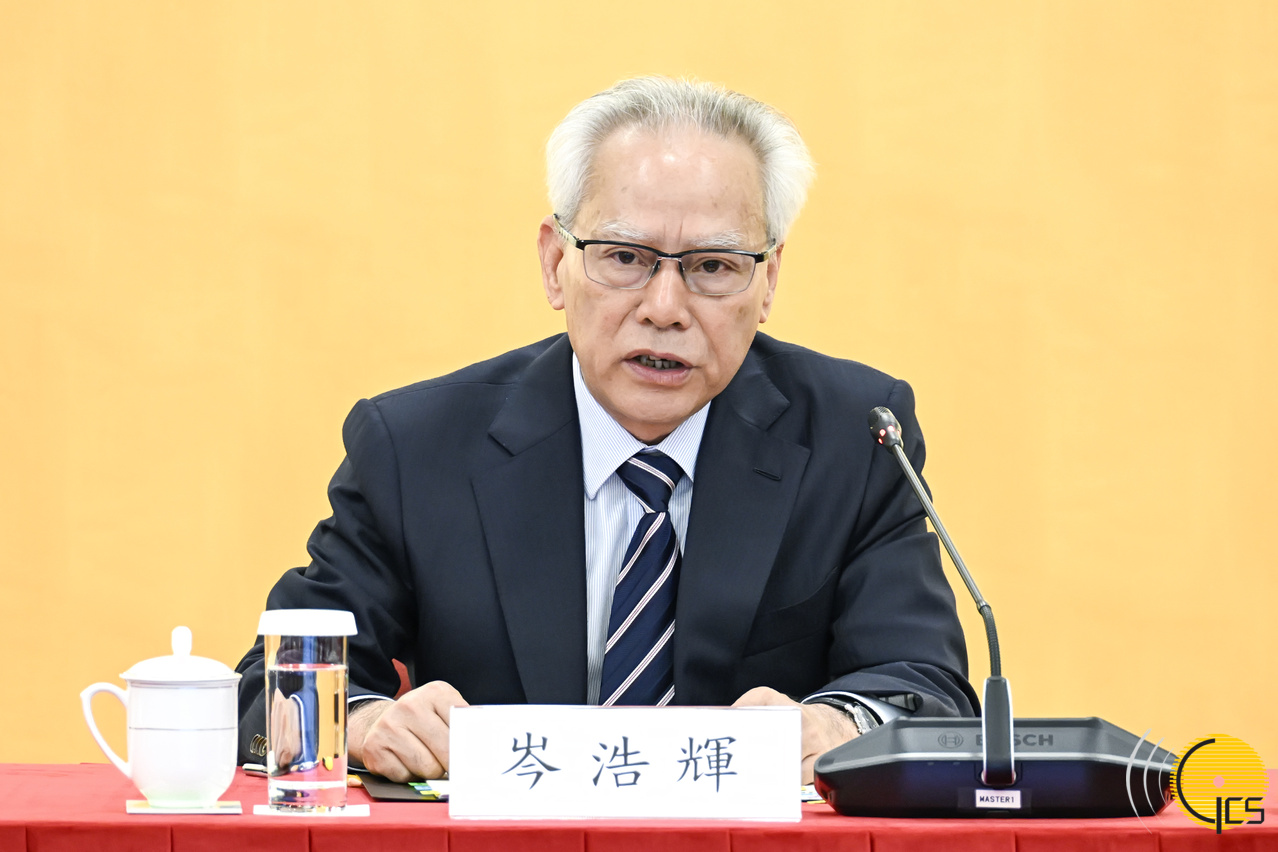
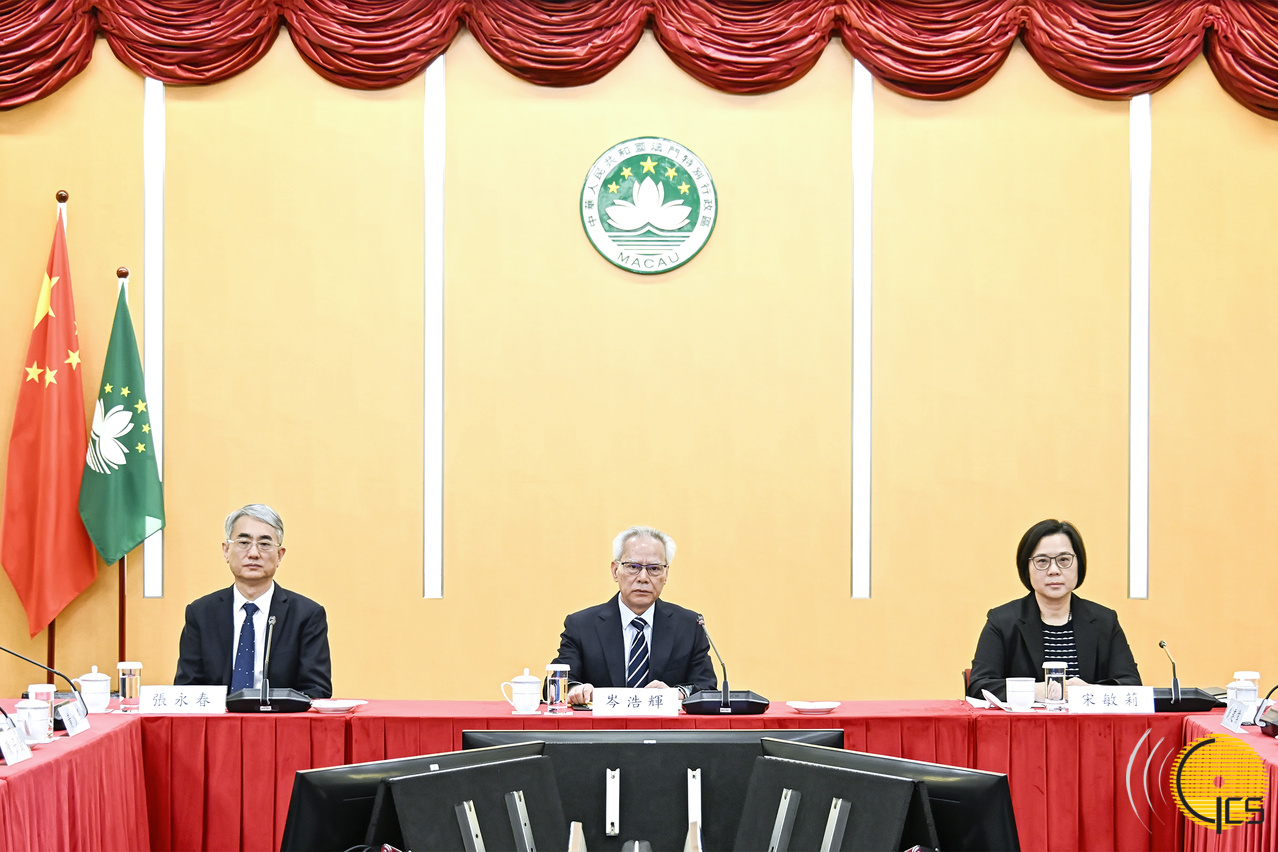
 The Chief Executive, Mr Sam Hou Fai, chairs a meeting on the formulation of the "Third Five-Year Plan for the Social and Economic Development of the Macao Special Administrative Region (2026–2030)".
The Chief Executive, Mr Sam Hou Fai, today stressed that formulation and implementation of the Third Five-Year Plan for Economic and Social Development of the Macao Special Administrative Region (MSAR) is the city’s most important task this year, and a major undertaking for the current-term Government.
Mr Sam reiterated the need to align Macao’s five-year blueprint closely with the country’s 15th Five-Year Plan, while taking into account Macao’s own realities.
The Chief Executive today convened a meeting at Government Headquarters to discuss the formulation of Macao’s Third Five-Year Plan. The meeting was attended by the President of the Legislative Assembly, Mr Cheong Weng Chon; the President of the Court of Final Appeal, Ms Song Man Lei; all principal officials; the Prosecutor-General, Mr Tong Hio Fong; representatives from the offices of principal officials; and the team from the Policy Research and Regional Development Bureau responsible for the drafting work.
All sources of policy must work closely together, coordinate effectively, and jointly complete all work related to preparation of the MSAR’s Third Five-Year Plan, said Mr Sam. Throughout the process, the Government would promote public awareness of the plan, widely solicit views from all sectors of society, encourage broad participation across Macao, and build greater social consensus.
The meeting began with a review of the work carried out to date by the leading group for the formulation of the MSAR’s Third Five-Year Plan and the dedicated task force responsible for drafting it.
Mr Sam noted that overall progress in the planning process has been smooth, with all bodies involved actively providing input. The drafting team is currently preparing an initial draft, including a consultation document, while intensively conducting preliminary research and proactively gathering feedback from various sectors of society.
During today’s meeting, all the policy teams jointly discussed the framework and arrangements for the plan, in order to accelerate coordination of work on it, and ensure timely progress. The Chief Executive pointed out that the Government has successfully formulated and implemented two previous Five-Year Plans for the MSAR, and the experience gained offers valuable reference for the development of its Third Five-Year Plan.
Mr Sam set out three key requirements for the formulation and implementation of Macao’s Third Five-Year Plan, drawing on the spirit of the recently-concluded “Two Sessions” and particularly reflecting the content of the outline of the country’s 15th Five-Year Plan.
The first requirement mentioned by Mr Sam is to align proactively and closely with the country’s 15th Five-Year Plan and thoroughly implement its newly-set tasks and requirements.
Mr Sam urged all participants to develop deep understanding of the positioning and development themes of the country’s 15th Five-Year Plan, especially the provisions concerning Macao in the dedicated Hong Kong and Macao chapter. These must be prioritised and effectively integrated into the MSAR’s Third Five-Year Plan. Where Macao has the necessary conditions to align with key projects mentioned in other chapters of the country’s plan, such projects should also receive focused attention in terms of the MSAR’s planning work, he added.
The Chief Executive emphasised that in implementing the arrangements concerning Macao mentioned in the country’s Five-Year Plan, it is essential firmly to uphold the “One country, two systems” principle, implement the principle of “patriots governing Macao”, enhance law-based governance, and promote the healthy and sustainable development of Macao’s economy and society. Macao must leverage its unique strengths – being deeply rooted in the motherland and well-connected to the world – and play its due role.
Meanwhile, the MSAR must focus on advancing moderate economic diversification and deepening the development of “One Centre, One Platform, and One Base” and “One Highland”.
In integrating into and serving the national development agenda, six key tasks and four major infrastructure projects must be prioritised:
1. Strengthening of cooperation with the Chinese mainland in trade, science and technology, and cultural exchanges, and improvement of policies to facilitate Macao residents’ own development and their daily life on the Chinese mainland;
2. Promotion of orderly connectivity between Macao and the Chinese mainland’s financial markets, and deepened innovation-related collaboration in industry, academia, and the research sector;
3. Deepening of cooperation between Guangdong, Hong Kong and Macao, with a view to making breakthroughs in key areas, and promoting coordinated development of ports, airports, and rail transport. A key project is the Guangzhou–Zhuhai (Macao) High-speed Railway, with Macao needing to ensure that its own infrastructure is properly aligned to it. That includes advancing the construction of a rail link connecting a station for the high-speed line to the Hengqin boundary checkpoint;
4. Deepening Macao-Hengqin integration by advancing “physical connectivity”, “institutional connectivity” of rules and mechanisms, and “people-to-people connectivity”; and promoting key projects such as the Macau International Airport Hengqin Upstream Cargo Terminal, the Macao-Hengqin International Education (University) Town, and supporting Macao’s higher education institutions to extend their operations into Hengqin;
5. Improving mechanisms for Macao to play a greater role in the country’s opening-up. Macao should actively participate in high-quality cooperation within the framework of the “Belt and Road” initiative, strengthen internal and external connectivity, serve as a “precise connector” between China and Portuguese- and Spanish-speaking countries, and leverage Macao’s professional services to assist enterprises in going global; and
6. Leveraging Macao’s role as an important window for cultural exchange and mutual learning between Chinese civilisation and Western civilisation.
Mr Sam stressed that these key priorities must be prominently reflected in the city’s Third Five-Year Plan, with specific tasks clearly defined and detailed implementation arrangements made.
The second requirement laid out by the Chief Executive in relation to Macao’s Third Five-Year Plan is to conduct in-depth analysis of Macao’s internal and external development landscape relating to the next five years, to ensure the plan is forward-looking, scientific and practical.
Mr Sam said that the quality and effectiveness of the city’s Third Five-Year Plan would be enhanced by attention to two key aspects: concepts and methodology. The planning process must emphasise coordination, continuous reform and innovation, a people-centred approach, a strong focus on people’s livelihoods, and a problem-solving way of thinking, to address any constraints on economic diversification and on improvements to people’s well-being.
In terms of themes and key points, the plan must focus on high-quality development, highlight the importance of “upholding and improving the executive-led system”, and address “appropriate economic diversification” and the “balancing of economic development” with matters relating to “livelihoods, development with security, and internal integration with external connectivity”. The plan should also set scientifically-grounded and realistic targets for economic and social development.
The third requirement outlined by the Chief Executive is the use of major projects and policy initiatives as drivers to coordinate key tasks across all sectors and promote high-quality development.
Mr Sam offered specific guidance on the drafting of each chapter of the city’s Third Five-Year Plan, including: safeguarding national security; enhancing MSAR governance capability; advancing appropriate economic diversification; ensuring the high-quality development of the Guangdong-Macao Intensive Cooperation Zone in Hengqin; integrating advancement of education, science and technology, and talent development; the effective safeguarding and improvement of livelihoods; the building of a beautiful and technology-based Macao; and the establishing of a new regional development pattern with strong internal and external connectivity.
Responsibilities for drafting each chapter must be clearly defined, with implementation responsibilities and supporting roles clearly assigned, said Mr Sam. The plan would include a responsibility matrix outlining key indicators, major tasks, and key projects, and will establish mechanisms for monitoring implementation, evaluating progress, and coordinating policy.
The Chief Executive called on all participants to work in unity, displaying responsibility and cooperation, and to continue embracing the principle that Macao’s affairs are discussed and handled together by all. By doing so, those involved in the planning can successfully complete the formulation of a high-quality Third Five-Year Plan for the MSAR and chart a bright future for Macao’s long-term development.