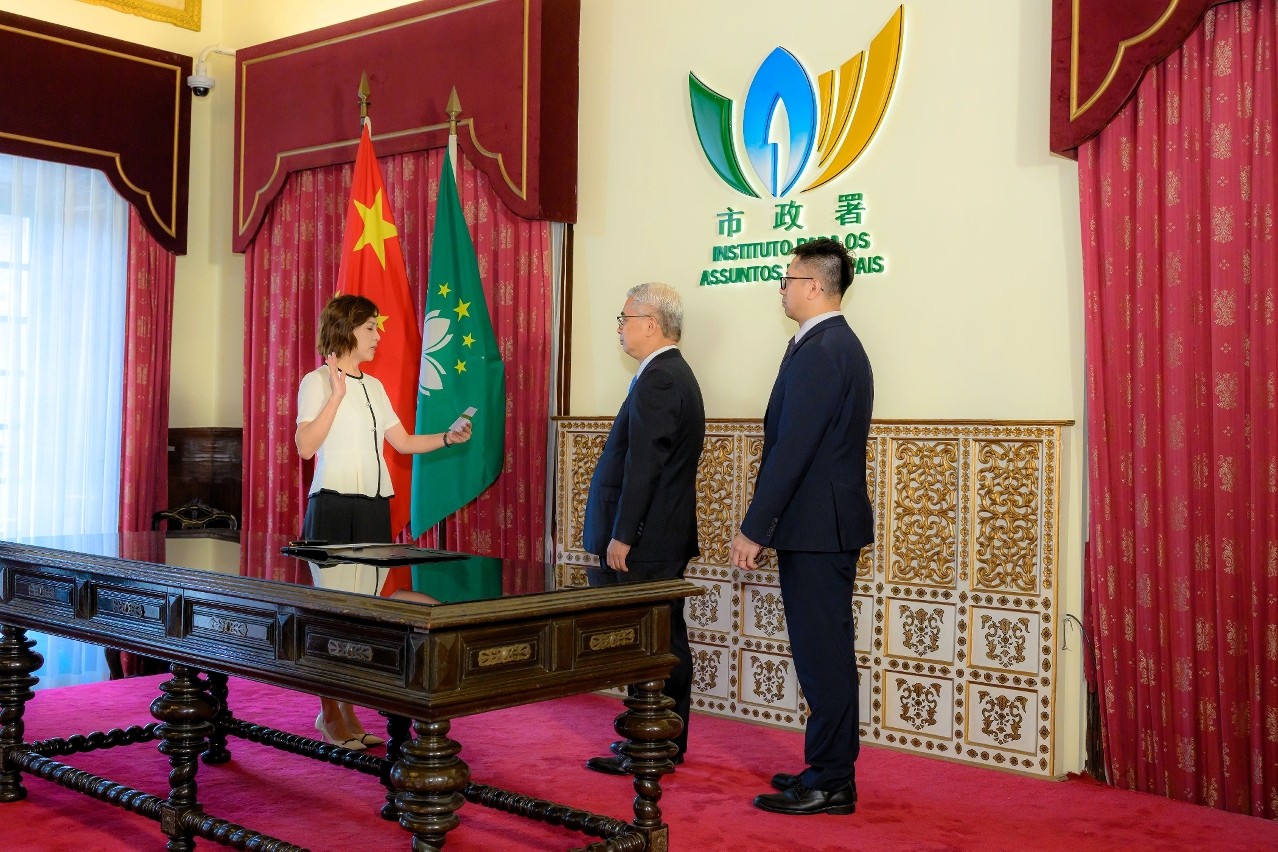
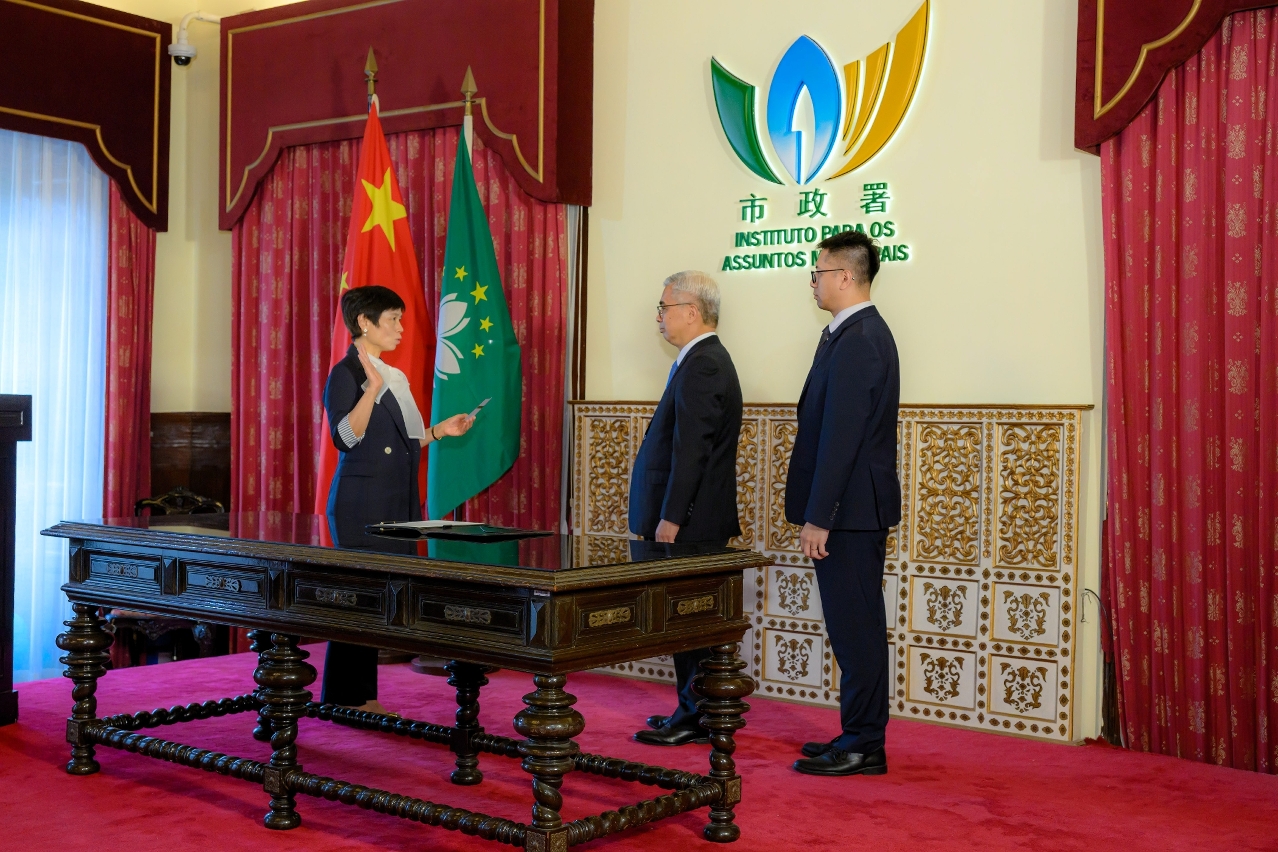
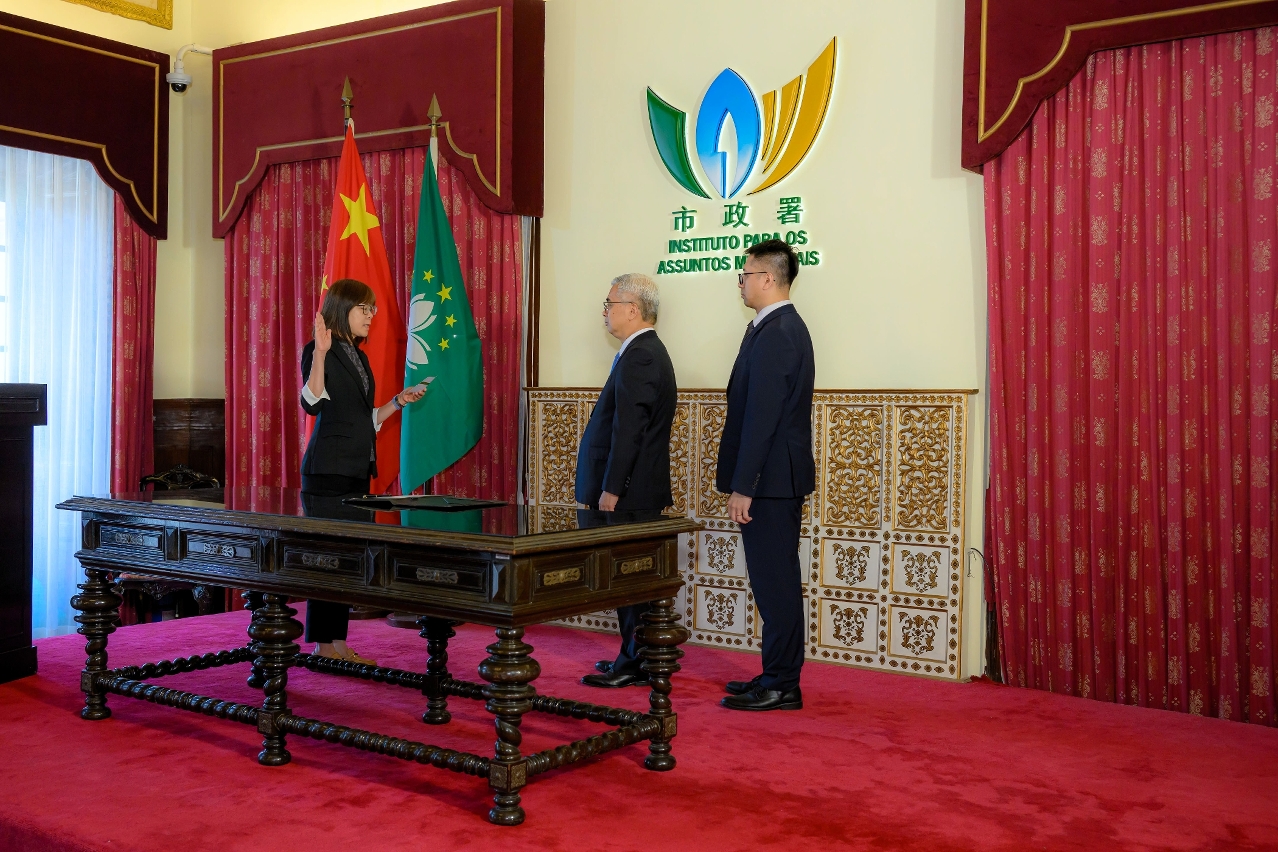
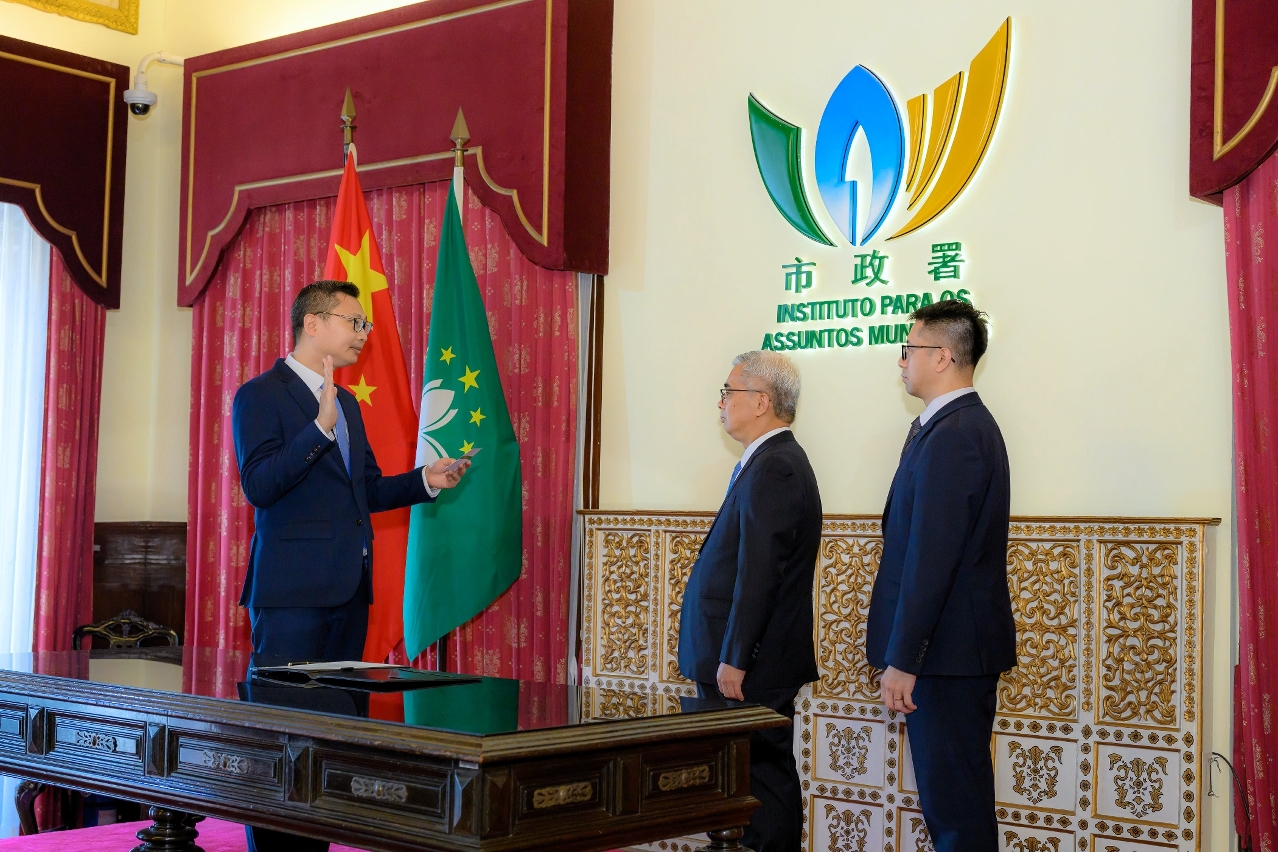
 Chao Wai Ieng is sworn in as Chairman of the Administration Committee on Municipal Affairs
To deepen the public administrative reform, the restructured functional framework of the Municipal Affairs Bureau (IAM) has been smoothly completed. The law on “Alteração à Lei n.º 9/2018 — Criação do Instituto para os Assuntos Municipais” (“Amendment of Law no.9/2018 ‘Establishment of Municipal Affairs Bureau’”) officially entered into force on 1 June. The inauguration ceremony of the newly appointed members of the Administration Committee on Municipal Affairs took place in the Grand Hall of IAM Building. The swearing-in of the four members of the Administration Committee on Municipal Affairs was administered by Wong Sio Chak, Secretary for Administration and Justice, and witnessed by Chang Cheong, Chief of the Office of the Secretary for Administration and Justice.
The inauguration ceremony took place at 10:00 a.m. on 3 June. Chao Wai Ieng and Tam Wai Fong, Chairman and Vice-Chairwoman of the Administration Committee on Municipal Affairs, Ung Sau Hong and To Sok I, Members of the Administrative Committee on Municipal Affairs, took their oaths and signed their certificates of inauguration one by one. During his speech at the inauguration ceremony, Wong Sio Chak raised “four expectations” to the newly appointed members of the Administrative Committee on Municipal Affairs. The first is to persist in reform and innovation, so as to launch work efforts with higher standards and service quality. The second is to uphold the concept of “people-oriented and service-oriented” governance and to widely collect the public’s views and listen to them earnestly, so that “follow-up and response is done for each and every public request”. The third is to promote streamlined administrative procedures for public convenience and leverage technology to accomplish efficiency, precision and professionalism in municipal affairs. The fourth is to attach importance to public relations techniques and publicity of policies, so as to promote unity between the government and public for advancement towards the same direction. Secretary Wong Sio Chak also encouraged all the members of the Administration Committee on Municipal Affairs to fulfil their duties with conviction, a pragmatic attitude, dedication and integrity. They should unite and lead all colleagues at IAM to demonstrate practical commitment and responsibility, thus promoting high-quality development of municipal affairs in Macao.
In his speech, Chairman Chao Wai Ieng expressed heartfelt gratitude to the Chief Executive and Secretary Wong for their trust and support for all the members of the Administrative Committee on Municipal Affairs, and to the various sectors of the society and all the colleagues for their long-term attention to the municipal work. He stated that in the future, IAM aims to achieve efficient and accomplishing service-oriented governance that is closely aligned with the policy direction of the Macao Special Administrative Region. IAM will strive to elevate municipal services to a new level and make new accomplishments from this new starting point based on the principles of “efficiency, precision and professionalism” and guided by the Secretary's “four expectations”.
Ai Yiping, Director of the Department of Social Development of the Liaison Office of the Central People’s Government in the Macao S.A.R, the leaders of the public departments in Administration and Justice area, the Members of the Consultative Committee on Municipal Affairs and Financial and Property Supervisory Committee of IAM, the management personnel of IAM and other guests attended the inauguration ceremony.
In accordance with Law No. 1/2026 “Alteração à Lei n.º 9/2018 — Criação do Instituto para os Assuntos Municipais” (“Amendment of Law no.9/2018 ‘Establishment of Municipal Affairs Bureau’”) and Administrative Regulation No. 14/2026 “Organização e funcionamento do Instituto para os Assuntos Municipais” (“Organisation and Operation of Municipal Affairs Bureau”), the restructured IAM has been streamlined into 8 departments and 19 divisions, which are responsible for eight core functions: provision of integrated public services, cultural and recreational activities and civic education, food safety, management of animals, markets and hawkers, environmental hygiene, parks, gardens, green areas and greening, construction and maintenance of municipal facilities, and municipal administration and supervision. The structures of the Consultative Committee on Municipal Affairs and Financial and Property Supervisory Committee remain unchanged.