

Macao SAR Government Portal
News
Green Public Day to Promote Waste Reduction at Source
The Green Public Day, which will take place tomorrow, on the last day of the 2015 Macao International Environmental Co-operation Forum and Exhibition (2015MIECF), will be held under the theme “Waste Reduction at Source Starts with Me”. It is open to the public and admission is free. By means of family activities, environmental-themed performances and magic shows, the Green Public Day aims to enhance environmental awareness and encourage the public to practise waste reduction at source. 2015MIECF aims to promote the concept of “Thinking Green, Going Clean, Living Cool”. Based on the theme of this year´s Green Public Day “Waste Reduction at Source Starts with Me”, a series of families activities related to environmental protection will be organised, in addition, there are workshops, games booths, stage performances and magic shows. An exhibition of the paintings of the winners of the “I´ve Got Solutions for Reducing Plastic Use” creative paintings competition will be held, to encourage the practise of reducing the use of plastic materials. Green Living Station will continue to display and sell all types of environmentally friendly products, to promote green consumption. Furthermore, visitors who have collected the stamps of the four mascot of the Environmental Protection Bureau, namely, “Mr. Earth”, “Mrs. Tree”, “Brother Cloud” and “Sister Flower” at the Green Stations in the exhibition revenue, will have a chance to redeem a variety of exquisite environmental gifts from the Environmental Protection Bureau. The four mascots will also show up at the venue for photo taking sessions with the public, so that everyone will be able to spend a pleasant green weekend. To encourage everyone to jointly participate in the development of a green city, live plants will be distributed to the public at the end of the event, so that they could continue the green concept. There will also be lucky draws and the winners will have the opportunity to receive a special edition electronic stored-value cards (with a value of MOP50.00), designed by the Environmental Protection Bureau with slogans to encourage green consumption and green transportation. At the exhibition venue, there is a booth for the public to apply as member of “Eco Fun – Waste Separation, it´s a Lot of Fun”. New members will immediately get 50 points, and existing members participating in the Green Public Day activities will also receive a bonus of 50 points (limited to local residents and each member is only eligible for one prize). Green Public Day is an ideal platform to promote the concept of environmental protection to Macao´s students, to enhance their environmental awareness, promote the principles of MIECF and encourage them to be more aware of the importance of caring for the environment. In this connection, the Organiser will provide on-site green guided tours to schools registered for this service. The Choir of the Luso-Chinese Vocational-Technical School will perform and sing environmental-themed songs. Through the songs lyrics, the teachers and students aim to disseminate environmentally-friendly attitudes and behaviours, bearing in mind that “Waste Reduction at Source Starts with Me”. A total of 10 schools and approximately 500 students have registered for the guided tour include Lingnan Middle School, Colégio Santa Rosa de Lima (English Secondary Section), Secondary Section of Escola Xin Hua, Primary Section of Escola Choi Non Chi Tai, Hou Kong Middle School, Premier School Affiliated to Hou Kong Middle School, Escola Nossa Senhora de Fátima (Primary Section) and Luso-Chinese Vocational- Technical School,. For the first time, civil servants are organised by the department responsible for welfare services under the Public Administration and Civil Service Bureau to visit the MIECF venue. To facilitate public access to the venue and promote green transportation, four shuttle bus routes will be provided on the Green Public Day, with departures from Avenida Doutor Mário Saores (Macau Square), Avenida Conselheiro Ferreira de Almeida (Pak Wai Public Car Park) and Estrada Marginal do Hipódromo (near Royal Supermarket). There is a new pick-up point at Rua de Guimarães, Taipa (Central Park, in front of Nova Park Building) to and from the exhibition venue (Venetian Macao-Resort-Hotel). For further information, please visit the official website – wwww.macaomiecf.com. Furthermore, free parking will also be available at Hall D of Venetian Macao-Resort (from 9:30 a.m. to 5:30 p.m.), on a first come, first served basis. All are welcome to visit MIECF, along with relatives and friends.
…
Strengthening ties with Guangzhou over free trade zone
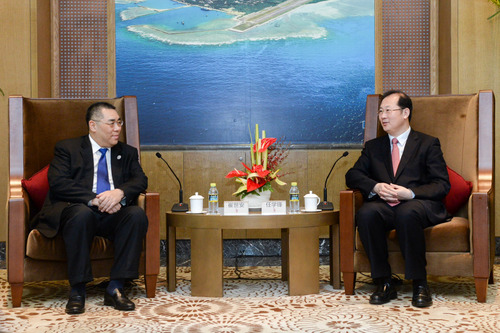
The Government will press ahead on Guangzhou-Macao co-operation over the pilot schemes under the Closer Economic Partnership Arrangement (CEPA) and development of free trade in Nansha district, the Chief Executive, Mr Chui Sai On, said today. The pilot schemes in Nansha include facilitated travel for pleasure crafts, construction of a cruise terminal, a training base for tourism and development of cultural and creative industries. Leading a delegation to Hainian province in advance of tomorrow’s opening of the Boao Forum for Asia Annual Conference 2015, Mr Chui had met with the Secretary of the Guangzhou Communist Party of China Municipal Committee, Mr Ren Xuefeng. The Government is pleased to share its experience in service industries and to work closely with the Guangzhou government in exploring more opportunities in the Portuguese-speaking countries, he said. Under the country’s development blueprint, the Government would join hands with the Guangdong government in more innovative structural reforms. Mr Chui thanked the Central Government for enabling Macao to participate in projects in the free trade zone in Guangdong, which comprises two sections – Hengqin in Zhuhai and Nansha in Guangzhou. Mr Chui said he was pleased to meet with Mr Ren at the Forum, to explore more co-operation opportunities with Guangzhou. Mr Ren said he hoped co-operation in tourism would be strengthened through the development of free trade zone and Macao’s commercial and trade co-operation service platform between China and the Portuguese-speaking countries, adding that Macao’s position in tourism was irreplaceable. Officials who also attended the meeting were Chief-of-Office of the Chief Executive’s Office Ms O Lam, Director of the Government Information Bureau Mr Chan Chi Ping, Director of the Protocol, Public Relations and External Affairs Office Mr Fung Sio Weng; Member of the Standing Committee and Secretary-general of the CPC Guangzhou Provincial Committee Mr Chen Guo, Vice Mayor Mr Luo Weifeng, Director General of the Bureau of Foreign Trade and Economic Cooperation of Guangzhou Municipality Mr Xiao Zhenyu, and Director General of Foreign Affairs Office of Guangzhou Mr Liu Baochun.
…
IFT holds The Language of Images of East and West – Exhibition of Creative Works by Cai Guo Jie
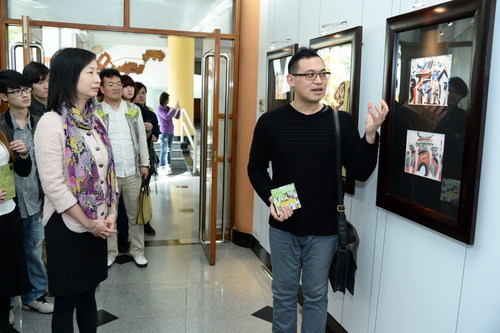
To celebrate the 20th anniversary of the Institute for Tourism Studies (IFT), IFT has the honour to invite Mr. Cai Guo Jie, renowned local artist, to exhibit his paintings created under the theme “Macao Typical Architecture”, allowing the public to have an opportunity to appreciate from a different perspective, the buildings that have been surrounding us. IFT has devoted a lot of effort to promote and develop cultural and creative industries. In addition to providing diversified courses, in 2015, the Institute organised a course series entitled “Macao Contemporary Artists Series”, and invited a number of renowned local artists including Lai Sio Kit, Cai Guo Jie and Denis Murrell to share their successful experiences with the students, inspiring the new generation to become talents in the cultural and creative areas. “Colouring along the City” is one of the courses under this series which is taught by Mr. Cai. The exhibition “The Language of Images of East and West – Exhbition of Creative Works by Cai Guo Jie” is based on Cai’s exploration of the local “East Meets West” cultural environment, after he moved to Macao in 2001, from Taiwan. During the process of painting, he blends all cultural elements that he cares for, to the unique buildings of Macao. The institute is keen on providing a platform to showcase art pieces of Macao artists and promote are enrichment to local communities. The exhibition takes place between 27 March and 5 July at the Educational Restaurant and the Team Building of IFT. All interested parties are welcome to pay a visit. To cope with Macao SAR Government’s policy to develop and promote creative industries, IFT started to offer short and fundamental courses in this area since 2011. IFT has continuously explored courses which are up-to-date, interesting and practical for the community. Today, courses in the areas of arts, design, multimedia production, souvenir production, etc. are running at IFT. Besides, the institute has been offering the Art Administration Programme for four years and has invited renowned professors from local and overseas as instructors, training up local professional in this field. IFT will continue offering more diversified cultural and creative courses to develop more local professional in this area.
…
Green Business Co-operation Day Promotes Exchange and Co-operation Opportunities for Enterprises
Green Business Co-operation Day took place today. As one of the key activities under MIECF, the event consists of two sessions of the Green Forum, as well as the Networking Cocktail Reception and Signing Ceremony. At the Networking Cocktail Reception and Signing Ceremony, agreements for 25 co-operation projects have been signed, involving environmental information exchange and technical co-operation, collaboration in environmental protection projects and agent of environmental products. At the same time, several green business exchange and matching sessions was held. With regards to the Green Showcase, a total of 450 exhibitors took part in showcasing their products and services. Different exhibition zones were set up to facilitate co-operation between the exhibitors and buyers, in their search for business opportunities. At one of the sessions of the Green Forum held under the Green Business Co-operation Day, participants discussed on how the business community could jointly create clean air. The participants believed that the society should reduce the use of natural resources and disposable resources, and efficiently recycle resources, to protect the environment and educate our next generation. One of the participants shared his experience of an energy company, pointing out that currently the market demands more advanced technology and methods to make use of renewable energy to reduce pollution. However, he considers that it is crucial that people increase their awareness in environmental protection, so that, while everyone put in a little more effort, we can make progress in improving the quality of air as well as the use of energy and create opportunities. At the session discussing the relationship between clean air and environmentally friendly transportation, the participants talked about the present situation of green transportation and the respective technical level and pointed out that environmental protection can effectively improve the exhaust emissions of the cars and therefore it is necessary to improve the respective car accessories in all aspects, to gradually promote and encourage wider use of environmentally friendly cars. The two sessions attracted over 360 participants. Green Business Co-operation Day has for many years invited guests from Mainland China (especially from the Pan-PRD region), Asia Pacific, Europe and the Portuguese-Speaking Countries, to share market dynamics and co-operation opportunities. At the Networking Cocktail Reception and Signing Ceremony, agreements of 25 co-operation projects were signed, involving co-operation in green transportation and technology, co-operation in environmental projects and agent of green products. The signing parties come from Macao, Mainland China, Hong Kong, Vietnam, Singapore, Malaysia, and the Netherlands. Green matching and business negotiations were also conducted at the exhibition venue. Green Matching is a special service of MIECF to assist enterprises to promote their products and services and to seek co-operation opportunities. The hotel sourcing area was set up again this year, several well-known large hotels, including many local green hotels sent their staff to the venue to procure environmentally friendly products, including energy saving LED products, solar system equipment, air purifiers, sewage treatment equipment, electric vehicles, green cleaning products and waste recycling equipment. A number of government departments/public utilities/public schools also participated in the procurement negotiations. A large number of international well-known enterprises also sent staff to participate in the green matching, to discuss about co-operation in environmental technologies and seek investors and business partners. Green Showcase is an important part of MIECF. This year’s event was participated by more than 450 exhibitors from 22 countries and regions. The venue covers an area of approximately 16,900 square metres. The provinces and regions in the Pan-Pearl River Delta (generally known as “9+2”) continue to participate in the MIECF and set up their exhibition zones. The Thematic Pavilion and the Countries/Regions pavilions include the Exhibition Zone of the Ministry of Science and Technology, the Pan-PRD Region Exhibition Area, the Macao Exhibition Area, the International Area, Europe Pavilion, USA Area, and VIP Exhibition Zone. Enterprises from Portugal and Brazil, which are both Portuguese-Speaking Countries, also continue to participate. There are 16 local and overseas renowned VIP exhibitors who showcased their products and services, including renewable energy, energy efficiency, energy-saving products, green building services, power management and electric vehicles. Buyers from the Pan-PRD Region and Southeast Asia were also invited to attend and hold green matching with the exhibitors. The Hosted Buyer Programme, which has been very efficient and is very popular among the exhibitors, continues to be available this year. Business matching and meetings are arranged for the buyers recommended by the exhibitors with the exhibitors, and help to enhance the efficiency and the professional standard of the event. The Green Matching between associations and chambers of commerce of the environmental industry, the networking cocktail of the environmental sector serve as a platform between associations of the environmental sector, chambers of commerce and trade promotion agencies. A Green Building Industry Networking Session is scheduled for tomorrow, to give an opportunity to the construction sector and relevant industries to exchange information about the current advanced technology and information, as well as to promote co-operation opportunities. The Macao SAR Government has launched the “Environmental Protection and Energy Saving Fund” and the “Environmentally Friendly Products Specifications Proposal”. Exhibitors could take this opportunity to know more about the two.
…
Environmental Experts Share Their Insights at the Green Forum
The 2015 Macao International Environmental Co-operation Forum and Exhibition (2015MIECF) was officially opened today. This year’s Green Forum consists of six sessions and one seminar. Dr Gro Harlem Brundtland, Former Prime Minister of Norway, former Chair of the World Commission on Environmental Development (WCED) (known as the “Brundtland Commission”), UN Special Envoy on Climate Change, Former Director-General of the World Health Organization (WHO), and generally recognised as the “Mother” of sustainable development, delivered her keynote speech this morning on how to face and resolve issues relating to climate change and energy, so as to ensure global sustainable development. According to Dr Brundtland, 2015 is a crucial year for global foresight and collaboration, putting to the test our ability in tackling the real danger of climate change, and to agree on the goal of sustainable development, these are our common responsibilities for the safety and well-being of our present and future generations. In fact all the parties involved are working together and eventually it will become a strength that impact on all, and show how new awareness will be shared across the world. She said that energy is crucial, for without energy, there is no development. Without sustainable energy, no sustainable development can be achieved. Dr Brundtland pointed out that, with a population of nearly 60 million, the Pearl River Delta region has been identified by the World Bank as the world’s largest urban area, in terms of its area and population. Development patterns in that region will indeed influence, not just the millions living there, but the impact will be on a larger, global scale, involving the future of man as well as its relationship with Planet Earth. According to an assessment carried out in January 2015, seven out of ten Chinese cities with the best air quality are located in the Pan-Pearl River Delta (PPRD) region, where Hong Kong, Macao and Guangdong province are. Compared to a survey conducted in 2013, when the PPRD region was assessed as the most polluted region in the whole China, it shows that the air quality in the region has significantly improved. Dr Brundtland believes that in face of the pressing challenges, clear policies are needed. For instance, Macao needs to work towards its stated goal as a “green low carbon city”. Clean air and using renewable energy, reducing the use of coal are necessary. This is not just an issue on how to face climate changes, but above all to reduce harm to the public health. In order to bring all countries and peoples into an era of sustainable development and progress, while protecting Planet Earth, an approach with wide coverage and sustainability is needed, and to overcome poverty and safeguard dignity. Within which, improvement in sanitary conditions and education for all, are viable and acceptable alternatives. A Special Interview Session with Dr Gro Harlem Brundtland will be scheduled for tomorrow afternoon (27 March), to enable participants to know more about her insights, strategies and experience on the world´s environmental protection movement, green economy, climate change and sustainable tourism. The interview session will be moderated by Professor Zhao Wei, Rector of the University of Macau. A Q&A session will be held during which participants will have an opportunity to interact and exchange opinions with one of the world´s top environmentalists. On the other hand, two sessions of the Green Forum were held today, respectively, “The Business Case for Better Air Quality - Solutions for the Commercial and Industrial Sectors” and “Reviewing Air Quality and the Transportation Industry”. Several other sessions will be held tomorrow (27 March), under the following themes: “Strategizing Climate Change Mitigation – Innovation and Policy and Technology”, “Clean Urban Air – Lessons Learnt and Future Trajectories”, “Green Chemical Forum – Standardization Drives the Sustainable Development of Chemical Industry”, and the “Pan Pearl River Delta Region Session – Air Prevention Policies and Treatment Technology in the Pan-pearl River Delta Region Roundtable Discussion”. Session 3 - “Strategizing Climate Change Mitigation – Innovation in Policy and Technology”, will analyze various strategies to mitigate climate change, including: promoting innovation, technology transfer, supportive policies and strategies: demonstrating systemic impacts of mitigation policy options: and fostering enabling conditions to mainstream mitigation concerns into sustainable development. While Session 4 – “Clean Urban Air – Lessons Learnt and Future Trajectories”, will showcase various success stories of prominent megacities in making the standard for good air quality, and to discuss the key factors that reduced air pollution and emissions without compromising economic growth. Critical solutions in relations to the cross-boundary and environment factors will be discussed. The Carbon Forum Asia Workshop 2015, a concurrent event held during MIECF, is organised for the first time in Macao by the International Emissions Trading Association (IETA). On the first day of the two-day event, two workshops were held today under the themes “State & Trends of Carbon Pricing in Asia and Beyond” and “China´s National Carbon Market: Expectations and Outlook”. Top enterprises, representatives of the financial sector and government officers from Asia Pacific and the world were invited to interact and exchange their insights.
…
Grand Opening of 2015MIECF Green Platform for the Environmental Industry
The 2015 Macao International Environmental Co-operation Forum and Exhibition (2015MIECF) takes place for three consecutive days starting from today. This year’s MIECF is held under the theme “Green Economy - Solutions for Clean Air”. Representatives from green enterprises and environmental industry, experts and academics from around the world joined in Macao to discuss current hot environmental issues. MIECF continues its role as a green platform, providing the opportunities and environment for promoting collaboration between operators of the environmental industry around the world and create business openings. The opening ceremony took place at 10:00 am this morning at the Venetian Macao-Resort-Hotel. Officiating guests included the Chief Executive of Macao SAR, Mr Chui Sai On, Deputy Director General of the Liaison Office of the Central People´s government in the Macao SAR, Mr. Yao Jin, Deputy Commissioner of the Ministry of Foreign Affairs of the People´s Republic of China in Macao SAR, Mr Pan Yundong, Vice Minister of Ministry of Science and Technology of the People´s Republic of China, Dr Zhang Laiwu, Vice-Governor of the People´s Government of Jiangxi Province, Mr Zheng Wei Wen, Executive Vice-Governor of the People´s Government of Hunan Province, Mr Chen Zhaoxiong, Vice-Governor of the People´s Government of Guangdong Province, Mr Xu Ruisheng, Vice President of the People´s Government of Guangxi Zhuang Autonomous Region, Mr Tang Renjian, Vice Chairman of the National Committee of the Chinese People´s Consultative Conference of Yunnan Province, Mr Wang Chengcai, Secretary for the Environment of Hong Kong SAR, Mr Wong Kam-Sing, Former Prime Minister of Norway, chaired the World Commission on the Environmental and Development (the “Brundtland Commission”), Special Envoy on Climate Change of the United Nations and Former Director-General of the World Health Organisation, Dr Gro Harlem Brundtland, Director General of the Department of Science, Technology and Standards, Ministry of Environmental Protection of the People´s Republic of China, Mr Xiong Yuehui, representing the Minister of Environmental Protection of the People´s Republic of China, Mr. Chen Jining, the Deputy Director General of the Department of Resource Conservation and Environmental Protection, National Development and Reform Commission of the People´s Republic of China, Ms Ma Rong, representing the Chairman of National Development and Reform Commission of the People´s Republic of China, Mr Xu Shaoshi, Secretary for Economy and Finance of Macao SAR, Mr Leong Vai Tac, Secretary for Transport and Public Works of Macao SAR, Mr. Raimundo Arrais do Rosário, Deputy Secretary General of the People´s Government of Sichuan Province, Mr He Luzhang, Deputy Secretary General of the People´s Government of Guizhou Province, Mr Wu Qiang, Director-General of the Department of Ecology and Environment Protection of Hainan Province, Mr Deng Xiaogang and the Deputy Director-General of the Environmental Protection Department of Fujian Province, Mr Yu Pinghe. Speaking at the Opening Ceremony, the Chief Executive of Macao SAR, Mr Chui Sai On said that the government will strengthen urban air pollution control, and develop relevant measures to improve air quality, to be in line with the carbon dioxide reduction targets of our country. Mr Chui said that the government will continue to improve the quality of life of the citizens, with the objective of developing Macao as a World Tourism and Leisure Centre as well as a trade and economic co-operation service platform between China and the Portuguese-speaking countries. Mr Chui added that the Macao SAR Government will continue to deepen and promote regional environmental co-operation, especially collaboration with the Pan-PRD provinces/regions and co-operation between China and the Portuguese-speaking countries. In order to meet with the demands of the new era of environmental protection, the Government will nurture the service-oriented environmental industry, and through the building of a region with clean air, promote the construction of a low-carbon and liveable city. MIECF continues to offer international forums, exhibition, business matching and networking opportunities to the participants, to develop fully its role as a green platform designed to promote the development of the environmental industry and environmentally-friendly technologies. The Vice Minister of Ministry of Science and Technology of the People´s Republic of China, Dr Zhang Laiwu, Director General of Department of Science, Technology and Standards, Ministry of Environmental Protection of the People´s Republic of China, Mr Xiong Yuehui, and the Deputy Director-General of the Department of Resource Conservation and Environmental Protection, National Development and Reform Commission of the People´s Republic of China, Ms Ma Rong, gave keynote speeches at the Opening Ceremony. Vice Minister Dr Zhang Laiwu said that future of the environmental co-operation between Mainland China and Macao is promising, and that a lot of works have been done in the area of science and technology co-operation. He said that co-operation projects have been launched in the field of environmental protection, that such co-operations have already been institutionalized. He stressed that results have been achieved, particularly in the areas of transportation, environmental pollution, reduction of carbon emission, and electric car, and that the next step would be to carry out more works in the field of environmental protection. Mechanisms to maintain the said co-operation are already in place, he said. Mr. Xiong Yuehui pointed out that there will be growth in the environmental industry within the next five years and that it will become a new growth area for the economy. He said that the government will invest significantly in technical engineering and in energy efficient projects, to promote the development of the environmental industry. In her keynote address, Ms. Ma Rong said that it is necessary to accelerate and promote environmentally friendly construction, as environmental protection will be a new norm in China´s development process and a new pillar of the economy. She stressed that, back in 2013, the State Council has already made plans for the development of the environmental industry, and the country will take low-carbon development as a basis to turn the environmental industry into new pillar for the country´s industry. Dr Gro Harlem Brundtland, Former Prime Minister of Norway, who chaired the World Commission on the Environment and Development, the “Brundtland Commission”, Special Envoy on Climate Change of the United Nations and Former Director-General of the World Health Organization (WHO) delivered her keynote speech during the Opening Ceremony. At the Green Forum tomorrow (27 March), experts and academics from different countries and regions will continue to express their insight on various environmental issues. Through the Green Matching, Green Exhibition and Green Networking, exhibitors and buyers will promote business co-operation and jointly create business opportunities.
…
Employment survey for December 2014 – February 2015
Information from the Statistics and Census Service (DSEC) indicated that both the unemployment rate (1.7%) and the underemployment rate (0.4%) for December 2014-February 2015 continued to remain stable as in November 2014-January 2015. Total labour force was 403,400 and the labour force participation rate stood at 74.0%. Total employment was 396,500, a decrease of 1,300 from November 2014-January 2015. Analysed by industry, employment in Hotels, Restaurants & Similar Activities and Construction saw decrease. Number of the unemployed was 6,900, up by 200 from November 2014-January 2015; fresh labour force entrants searching for their first job accounted for 9.2% of the total unemployed, down by 2.1 percentage points. In comparison with December 2013-February 2014, the labour force participation rate increased by 0.6 percentage points, while both the unemployment rate and the underemployment rate remained constant.
…
Visitor arrivals for February 2015
Information from the Statistics and Census Service (DSEC) indicated that attributable to the Lunar New Year holidays, visitor arrivals increased by 4.5% year-on-year to 2,676,024 in February 2015; same-day visitors totalled 1,574,123, up by 13.8%. The average length of stay of visitors decreased by 0.1 day year-on-year to 0.9 day; overnight and same-day visitors had an average stay of 1.8 days and 0.2 day respectively. Visitors from Mainland China rose by 10.7% year-on-year to 1,898,650, coming primarily from Guangdong Province (965,127), Zhejiang Province (64,430) and Fujian Province (58,351). Mainland visitors travelling under the Individual Visit Scheme set a new single-month record of 1,141,165, up substantially by 38.9%. Visitors from Taiwan (74,176) and the Republic of Korea (56,240) increased by 1.4% and 7.3% respectively year-on-year, while those from Hong Kong (522,796) decreased by 5.2%. Long-haul visitors from the United States (11,693), Australia (5,665), Canada (5,245) and the United Kingdom (3,920) registered year-on-year decline. Regarding mode of transport, visitor arrivals by land totalled 1,585,052, up by 15.1% year-on-year; visitors entering through the Border Gate accounted for 85.3% of the total, at 1,352,055, up by 13.0%, while those arriving via the Checkpoint of Cotai rose notably by 29.9% to 231,247. Visitor arrivals by sea decreased by 8.9% year-on-year to 915,999, of which visitors entering via the Outer Harbour (576,616) and the Provisional Ferry Terminal in Taipa (287,156) dropped by 8.7% and 11.0% respectively. Visitor arrivals by air decreased by 2.0% year-on-year to 174,973, with 174,036 entering via the airport. In the first two months of 2015, visitor arrivals reached 5,141,636, up by 1.5% year-on-year, with same-day visitors sharing 57.4% of the total. Visitors from Mainland China (3,568,302), Taiwan (151,159) and the Republic of Korea (125,031) increased by 4.8%, 0.1% and 12.1% respectively year-on-year, but those from Hong Kong (995,996) and Japan (38,685) dropped by 4.8% and 24.8%. Moreover, long-haul visitors from the United States, Australia, Canada and the United Kingdom recorded year-on-year decrease.
…
Photos of a misty Macao in government news app
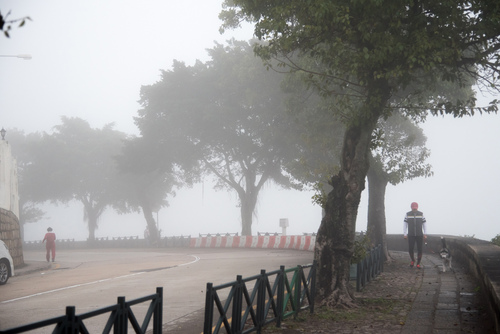
A new collection of photographs on the season of mist is now available at the Government Information Bureau’s news application “MSAR News”. “Macao in mist” is a set of ten photographs which captured the phenomenon caused by the mass fine droplets of water in the air here in Macao. Through the camera of the Bureau’s photographer Pedro Kong, a thick layer of fog blankets buildings, sea view and driveway, giving a sense of mystery. More photo collections are available at “MSAR News”, which can be downloaded in App Store and Google Play. Other functions of the app include“News”, “News Features”, “Hot News”, and “Hot News Photos”, offering users more real-time news, government information, pictures and local weather reports.
…
Findings of the annual study of Macao’s Tourism Carrying Capacity, 2013 and 2014
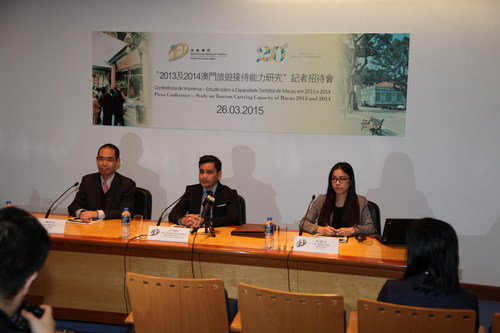
Background 1. First commissioned by the Secretariat for Social Affairs and Culture in 2003, the Institute for Tourism Studies (IFT) has been conducting the annual Tourism Carrying Capacity (TCC) study. The objective of the study is to determine the optimum number of visitors that Macao can receive per day. Methodology 2. There are several and varying methods for assessing a tourism destination’s optimal capacity to receive visitors. In Macao’s case, IFT adopts two approaches for determining the optimum number of visitors. The first approach is based on the concept of social carrying capacity (SCC), which uses subjective measures perceived and experienced by residents and visitors. The second approach assesses changes in the physical carrying capacity (PCC) of key tourism infrastructure and physical facilities. 3. The SCC approach estimates optimum carrying capacity based on Macao residents’ satisfaction with factors affecting their quality of life and visitors’ satisfaction with the quality of their visiting experience. These subjective factors include (a) perceived level of crowdedness, (b) satisfaction with the quality of the environment, (c) satisfaction with transportation services, (d) service quality and (e) waiting time at food and beverage as well as retail outlets, (f) satisfaction with tourist attractions as well as recreational activities, (g) satisfaction with border immigration clearance. Visitors also provide their satisfaction (h) hotel service performance and (i) availability of hotel rooms. Multiple regression modeling of the relationship between these factors and daily visitor numbers help determine an estimated optimum capacity. 4. Data for the SCC approach is collected via an extensive field survey conducted throughout the year. Results for 2013 is based on data collected from 6,005 respondents (of which 2,987 were residents and 3,018 visitors). For 2014, survey data were obtained from 6,007 respondents (2,991 residents and 3,016 visitors). 5. The PCC approach evaluates the physical and service carrying capacities of eight major tourism-related infrastructures and services. These include (a) hotel accommodation, (b) restaurant and dining facilities, (c) public buses, (d) taxis, (e) ferries, (f) border immigration clearance, (g) major non-paid visitor attractions, and (h) inbound tour operations. IFT collects data directly from organizations that manage, operate, or utilize the above facilities to gauge their physical service capacity to service residents and visitors. Findings 6. Based on IFT’s latest analysis using a social carrying capacity (SCC) approach, the estimated optimum carrying capacity of Macao for 2013 and 2014 are as follows: (* Please find attached file) 7. In terms of physical carrying capacity (PCC) several tourism services and facilities were able to increase their capacity to service visitors in 2013 and 2014 but there were also setbacks. a. Ferry services, inbound tour operating services, and border immigration clearance were able to maintain adequate or augment capacity to handle increased visitor numbers. b. The total number of hotel rooms is currently below the optimum number of visitors and may be inadequate particularly during peak periods but additional accommodations are in the pipeline from properties currently in development or planned. c. The physical capacities of transportation, especially taxis and public buses, remain strenuous. For example, there were reductions in the number of taxis in operations but several new licenses have been issued and additional ones are planned soon. As more visitors utilize the public taxis and buses as a means for transportation, the risk for a further squeeze will be likely, as residents and visitors share both transport facilities. d. Macao’s major visitor attractions and restaurants and dining establishments also face capacity issues. There are certain periods during the year in which service capacities of these sectors are adequate but on other days could be insufficient to meet the demand. Discussion 8. Compared to previous years, Macao’s tourism carrying capacity (based on the SCC approach) has increased in a stable manner, but reached a highpoint in 2013 and showed a leveling off in 2014. This trend suggests that Macao’s capacity to absorb visitors may have reached a saturation point in 2014. From a social perspective, this is likely due to residents’ beginning to grow weary of the effects of continued tourism growth on important quality of life issues such as deteriorating experience with public transport and perceived crowding in the street as well as deterioration in visitors’ travel experience caused by over-crowdedness and possible decline in tourism service quality in F&B and retail outlets as well as immigration borders. 9. Though critical measures were taken in 2014 to augment capacity in several areas (e.g., increasing the opening time of the border entry points, adding new taxi licenses) and crowd control measures during peak periods of visitation like the Chinese New Year golden week holiday period, the effects of these improvements were not proportional enough to the continued increase in the number of visitors especially on some peak days. Thus it is likely that both residents and visitors perceive an overall deterioration in overall conditions. About the annual TCC Study 10. Different methods for assessing a destination’s tourism carrying capacity will lead to different estimates, depending on the assumptions and techniques adopted. IFT will endeavor to explore other complementary methods to assess Macao’s tourism carrying capacity in order to provide accurate and reliable information and taking into account as many perspectives as possible for supporting better policy formulation and enhancement of Macao’s tourism development. 11. The TCC study is a retrospective study—it does not seek to impose future boundaries or limits to Macao’s tourism. It serves to indicate at which levels of visitor numbers were residents’ and visitors’ experience affected and thus provide important inputs to future planning and policy. Recommendations 12. To improve and enhance Macao’s tourism carrying capacity in the long run, the following general policy directions can be explored or discussed: a) It is important that physical capacity growth of key infrastructure and facilities is coordinated, balanced, and synchronous. Additional room capacity provided by recent (and upcoming) new hotel properties, for example, will not prove efficient if there is no corresponding increase or enhancement in other areas such as public transport and improvements in service quality. b) In the near future, it is highly recommended that measures be taken to moderate and balance the growth in visitor numbers so that it is managed in a stable method, avoiding any rapid surge or decrease. c) Greater selectivity in target source markets to achieve diversity and quality. d) Continued expansion of service infrastructure and facilities as well as availability and diversity of attractions. e) Encourage variations and coordination in the opening hours or periods of selected attractions as well as the scheduling of events in order to distribute demand more evenly throughout the year and throughout each day. f) Define certain zones for long-term development, delineating clearly areas where tourism development can be more concentrated as well as segregated from residential areas. g) Develop facilities or zones to cater to the needs of frequent cross-border shoppers, many of who visit Macao for one day, in order to reduce congestion at key areas of the city.
…